



The video link is at the bottom of the page.
1. Introduction
Jesus’ Last Days Prophecy is the first lesson in our series on eschatology – the study of the last things. Matthew 24 is frequently quoted as evidence that we are living in the Last Days. Therefore, we need to examine Jesus’ words carefully and determine the timeframe Jesus Himself gave for this prophecy.
A. When will it Happen?
Before Jesus gave the prophecy recorded in Matthew 24, He had already given His listeners a timeframe:
Assuredly, I say to you, all these things will come upon this generation.
Matthew 23:36
To understand Jesus’ Last Days Prophecy correctly, we therefore need to determine what Jesus meant by “this generation.”
This does not mean that every biblical prophecy concerning future events was fulfilled within that generation. As we proceed, we will distinguish Jesus’ Last Days prophecy from the future Final Harvest, resurrection of the dead, destruction of death, and the ultimate consummation of Christ’s Kingdom.
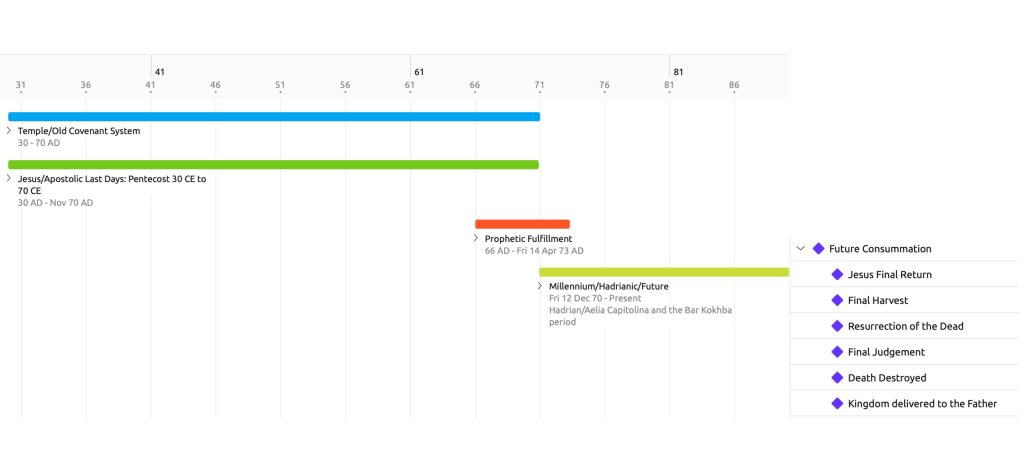
2. How Long is a Biblical Generation?
A. Forty Years
The Old Testament clearly associates forty years with a generation. The generation that rebelled against God in the wilderness passed away during Israel’s forty years of wandering.
So the LORD’s anger was aroused against Israel, and He made them wander in the wilderness forty years, until all the generation that had done evil in the sight of the LORD was gone.
Numbers 32:13
This association is stated even more directly in the Psalms:
For forty years I was grieved with that generation, and said, ‘It is a people who go astray in their hearts, and they do not know My ways.’
Psalm 95:10
Scripture therefore provides a clear precedent: a particular generation is associated with 40 years.
B. Four Hundred Years and Four Generations
Genesis 15 gives us another important chronological use of “generation.” God told Abraham that his descendants would be afflicted for four hundred years and that they would return “in the fourth generation.” Thus, within this particular prophecy, four hundred years are associated with four generations. This provides a biblical basis for observing an approximate hundred-year correspondence within this specific prophetic pattern.
Then He said to Abram: “Know certainly that your descendants will be strangers in a land that is not theirs, and will serve them, and they will afflict them four hundred years. And also the nation whom they serve I will judge; afterward they shall come out with great possessions. Now as for you, you shall go to your fathers in peace; you shall be buried at a good old age. But in the fourth generation they shall return here, for the iniquity of the Amorites is not yet complete.”
Genesis 15:13-16
As we proceed, we will see that Jesus’ prophecy was fulfilled within forty years, culminating in the destruction of Jerusalem and the Temple in 70 CE. We also see a remarkable secondary correspondence with the four-hundred-years/four-generations pattern of Genesis 15: about one hundred years after Jesus’ prophecy, the Hadrianic period brought another devastating judgment upon Jerusalem and Judea under Roman rule.
3. The Signs of the Times and the End of the Age
The questions in Matthew 24 arise directly from Jesus’ prophecy concerning Jerusalem and the Temple at the end of Matthew 23 and the beginning of Matthew 24.
Now as He sat on the Mount of Olives, the disciples came to Him privately, saying, “Tell us, when will these things be? And what will be the sign of Your coming, and of the end of the age?“
Matthew 24:3
See also Mark 13:3–4 and Luke 21:7.
The disciples’ question contains three matters that Jesus will address:
- When will these things be?
- What will be the sign of His coming?
- And of the end of the age?
These are three aspects of the disciples’ question, but we should not assume at the outset that they refer to three chronologically separate events. We must determine the meaning of each from Jesus’ answer and from how the New Testament uses expressions such as “this generation,” “coming,” and “the end of the age.”
A. When Will These Things Be?
Jesus had already given them the timeframe. Immediately before leaving the Temple, He declared:
Assuredly, I say to you, all these things will come upon this generation.
Matthew 23:36
Ending with:
Assuredly, I say to you, this generation will by no means pass away till all these things take place.
Matthew 24:34
Matthew 23:36 and Matthew 24:34 therefore provide chronological boundaries for the prophecy under consideration. Before leaving the Temple, Jesus declares that “all these things” will come upon “this generation,” and in Matthew 24:34 He again declares that “this generation” will not pass away until “all these things” take place.
As we have already seen, Scripture provides a strong forty-year precedent for a generation. Jesus gave this prophecy in 30 CE; forty years later, Jerusalem and the Temple were destroyed in 70 CE.
4. The Last Days Begin at Pentecost
A. Pentecost and the Beginning of the Last Days
Peter was one of the disciples who had heard Jesus’ prophecy concerning Jerusalem and the Temple (Mark 13:3). Jesus had declared that “all these things” would occur within that generation. At Pentecost, Peter now identifies the period in which he and his hearers were living as “the last days.”
But this is what was spoken by the prophet Joel:
Acts 2:16-20
‘And it shall come to pass in the last days, says God,
That I will pour out of My Spirit on all flesh;
Your sons and your daughters shall prophesy,
Your young men shall see visions,
Your old men shall dream dreams.
And on My men-servants and on My maidservants
I will pour out My Spirit in those days;
And they shall prophesy.
I will show wonders in heaven above.
And signs in the earth beneath:
Blood and fire and vapour of smoke.
The sun shall be turned into darkness,
And the moon into blood,
Before the coming of the great and awesome day of the LORD.
By applying Joel’s prophecy to the events of Pentecost, Peter recognised that he and his hearers were already living in the last days. He then confronted those gathered in Jerusalem with their rejection and crucifixion of the Messiah.
Him, being delivered by the determined purpose and foreknowledge of God, you have taken by lawless hands, have crucified, and put to death;
Acts 2:23
Peter therefore called his hearers to repentance:
Then Peter said to them, “Repent, and let every one of you be baptized in the name of Jesus Christ for the remission of sins; and you shall receive the gift of the Holy Spirit.
Acts 2:38
Peter then specifically warned his hearers concerning their own generation:
And with many other words he testified and exhorted them, saying, ‘Be saved from this perverse generation.’
Acts 2:40
Peter’s language is significant. Jesus had warned that judgment would come upon “this generation,” and at Pentecost Peter warned his hearers, “Be saved from this perverse generation.”
B. The Day of the Lord Was Still Approaching
Peter identified his own period as the Last Days, while Joel’s “great and awesome day of the LORD” was still presented as approaching. Pentecost therefore provides a clear early marker within this Last Days period, not its conclusion.
And it shall come to pass in the last days, says God,
Acts 2:19-21
I will show wonders in heaven above
And signs in the earth beneath:
Blood and fire and vapor of smoke.
The sun shall be turned into darkness,
And the moon into blood,
Before the coming of the great and awesome day of the LORD. And it shall come to pass
That whoever calls on the name of the LORD
Shall be saved
Peter therefore identifies the events of his day with Joel’s “last days.” The New Testament writers repeatedly use the same language of their own period, as we will see later in this lesson.
5. The Destruction of the Temple Ends the Last Days Period
Jesus prophesied the destruction of the Temple in 30 CE. The Temple was destroyed within the forty-year generation, in 70 CE.
“Do you not see all these things? Assuredly, I say to you, not one stone shall be left here upon another, that shall not be thrown down.”
Matthew 24:2
In 70 CE, the Roman legions under Titus captured Jerusalem. During the fighting, the Temple was burned, and the Temple complex was destroyed. The destruction was so extensive that Josephus later described the city as being laid level with the ground.
The destruction of the Temple in 70 CE therefore provides the primary forty-year fulfilment of Jesus’ one-generation prophecy. About 100 years after Jesus gave the prophecy, Hadrian began the Roman refounding of Jerusalem as Aelia Capitolina. As we shall see later, this provides a secondary correspondence with the four-hundred-years/four-generations pattern of Genesis 15. However, the fulfilment of Jesus’ prophecy does not depend upon this later event: the Temple had already been destroyed within the forty-year generation in 70 CE.
The present Western Wall (Wailing Wall) is not a surviving wall of the Temple itself; it formed part of the retaining wall supporting the expanded Temple Mount platform.
Therefore, the survival of this retaining wall does not contradict Jesus’ prophecy that the stones of the Temple buildings would be thrown down.
6. Taking a Closer Look at the Last Days Prophecy by Jesus
As Jesus laments over Jerusalem, let’s examine carefully what He is saying.
“O Jerusalem, Jerusalem, the one who kills the prophets and stones those who are sent to her! How often I wanted to gather your children together, as a hen gathers her chicks under her wings, but you were not willing!
Matthew 23:37-24:2; See also (Luke 13:34-35)
See! Your house is left to you desolate; for I say to you, you shall see Me no more till you say, ‘Blessed is He who comes in the name of the LORD!'”
Then Jesus went out and departed from the temple, and His disciples came up to show Him the buildings of the temple.
And Jesus said to them, “Do you not see all these things? Assuredly, I say to you, not one stone shall be left here upon another, that shall not be thrown down.”
Jesus then placed the fulfilment of this prophecy within the lifetime of that generation:
Assuredly, I say to you, this generation will by no means pass away till all these things take place.
Matthew 24:34
The timeframe is therefore important. Jesus prophesied the destruction of the Temple and declared that these events would occur within that generation. Forty years later, in 70 CE, the Temple was destroyed.
A. See! Your House Is Left to You Desolate
The Old Covenant had already been made obsolete through Christ and the establishment of the New Covenant. Nevertheless, as we shall examine shortly, Hebrews describes what had become obsolete and grown old as still being “ready to vanish away.”
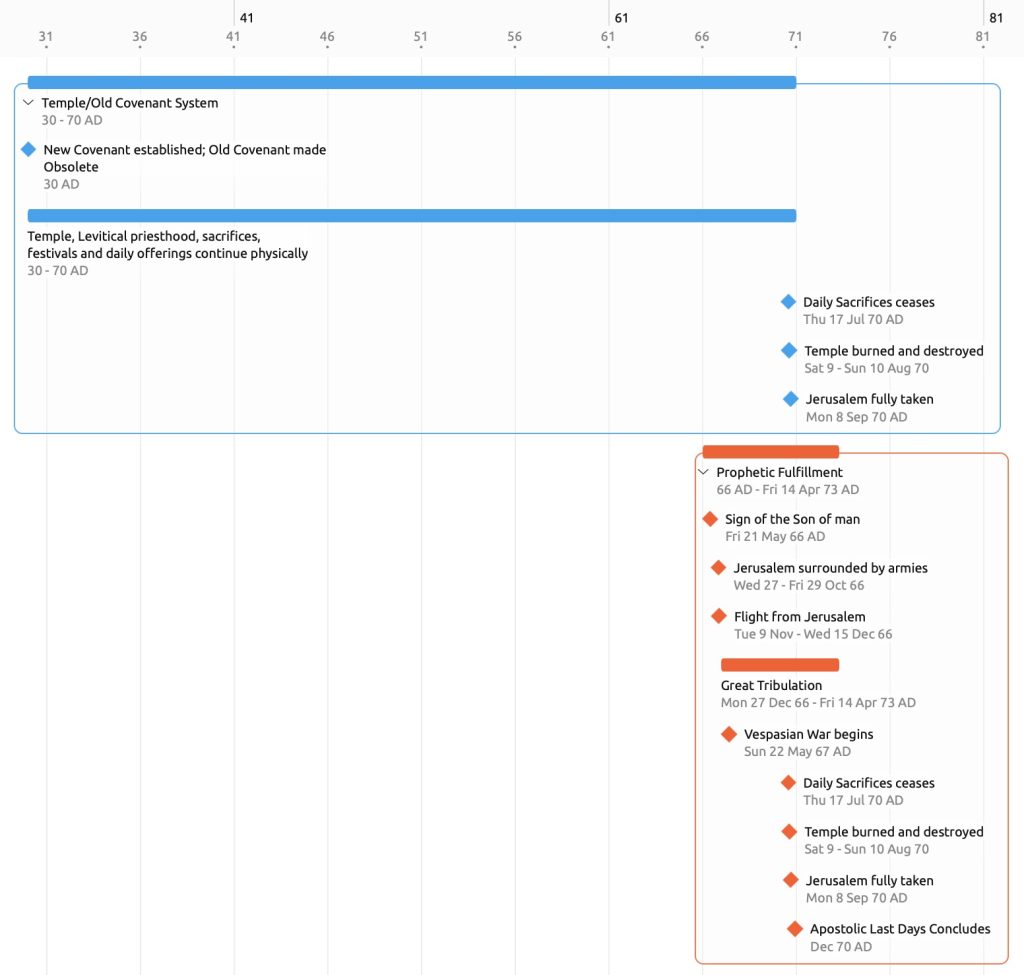
The Temple, Levitical priesthood and sacrificial system continued to function until 70 CE. With the destruction of the Temple, this remaining Old Covenant system finally ceased to be practised.
“Therefore when you see the ‘abomination of desolation,’ spoken of by Daniel the prophet, standing in the holy place” (whoever reads, let him understand),
Matthew 24:15
The abomination that causes desolation relates to the Roman armies coming against Jerusalem. Its initial fulfilment as a warning sign occurred when Cestius Gallus surrounded Jerusalem in 66 CE, while the resulting desolation culminated in the Roman destruction of Jerusalem and the Temple in 70 CE.
The phrase translated as “holy place” is ἁγίῳ τόπῳ (hagiō topō). Matthew does not further identify the location here, but Luke’s parallel account provides an important explanation of Jesus’ warning:
“But when you see Jerusalem surrounded by armies, then know that its desolation is near.
Luke 21:20
Matthew describes the “abomination of desolation,” while Luke describes Jerusalem “surrounded by armies” and says that its “desolation is near.” Read together, these parallel accounts identify the approach of the Roman armies as the warning sign that Jerusalem’s desolation was approaching.
During the siege, the Romans finally captured and destroyed the Temple on 10 August 70 CE. On 8 September, they took control of the remainder of Jerusalem, completing the conquest of the city.
The eagle (aquila) was the principal standard of a Roman legion. This provides important historical background for another statement in Jesus’ prophecy.

Cleveland Museum of Art
For wherever the carcass is, there the eagles will be gathered together.
Matthew 24:28
The gathering of the eagles, therefore, provides a striking image of the Roman forces gathering against Jerusalem. We will return later to Jesus’ reference to the “carcass.”
B. Jerusalem Surrounded by Armies
Jesus had told His disciples what to do when they saw Jerusalem surrounded by armies. In 66 CE, Cestius Gallus advanced against Jerusalem with XII Fulminata, detachments from other Roman legions, auxiliaries, and allied troops. He surrounded and attacked Jerusalem but then unexpectedly withdrew. During the subsequent Roman retreat, Josephus records the loss of 5,300 infantry and 480 cavalry.
The Roman withdrawal provided an opportunity for those who remembered Jesus’ warning to flee:
Then let those who are in Judea flee to the mountains, let those who are in the midst of her depart, and let not those who are in the country enter her. For these are the days of vengeance, that all things which are written may be fulfilled.
Luke 21:21-22
Following the Roman defeat and withdrawal, people began fleeing Jerusalem from 9 November 66 CE. As calculated in our lesson, Dating the Great Tribulation, this period of flight continued through the following weeks, probably ending around 15 December. Those who remembered Jesus’ warning now had the opportunity to flee from Jerusalem before the Great Tribulation began.
C. “Blessed is He Who Comes in the Name of the Lord” – The Kingdom Established
The New Covenant and the Kingdom were established through Jesus’ death in 30 CE. The Old Covenant was fulfilled in Christ at the cross, although the Temple and its sacrificial system continued for another forty years. During the siege of Jerusalem, the daily sacrifice finally ceased on 17 July 70 CE, and the Temple was destroyed the following month. I cannot over-emphasise the importance of this. The Kingdom is here now, and we reign now!
The Kingdom did not have to wait for the Millennium. Jesus established His Kingdom and began reigning in the first century, and we reign with Him now. The Millennium is a subsequent phase of Christ’s already-established reign, beginning after the Great Tribulation and the destruction of Jerusalem.
In our lesson on the 1335-day prophecy, we learned that there was a blessing for those who endured 1335 days from the Passover of 67 CE. I believe the Millennium began with the arrival of the Jerusalem captives to Antioch on 12 December 70 CE. Antioch became the centre of Christian Theology for 1000 years.
D. Jesus Predicts the Destruction of the Temple
The physical destruction of the Temple brought the remaining Old Covenant sacrificial system to an end. The Old Covenant had already been fulfilled in Christ, but sacrifices continued at the Temple until the siege of Jerusalem. On 17 July 70 CE, the daily sacrifice ceased. The following month, the Temple was destroyed.
Some contemporary Christians expect a rebuilt Temple and the restoration of animal sacrifices before Jesus’ final return. However, restoring the Old Covenant sacrificial system would contradict the finality of Jesus’ sacrifice. Under the New Covenant, God’s dwelling is no longer centred on a stone Temple; His people are the Temple of the Holy Spirit.
Between 9 and 10 August 70 CE, Josephus records that Titus initially sought to preserve the Temple. During the fighting, however, a Roman soldier threw a burning object into the Temple, and the fire spread beyond control. Despite Titus’ reported orders to extinguish it, the Temple was consumed.
Paul therefore teaches that the requirements of the Old Covenant were taken out of the way through the cross. Its food regulations, festivals, new moons and Sabbaths were shadows; their substance is Christ.
Having wiped out the handwriting of requirements that was against us, which was contrary to us. And He has taken it out of the way, having nailed it to the cross… So let no one judge you in food or in drink, or regarding a festival or a new moon or sabbaths, which are a shadow of things to come, but the substance is of Christ.
Colossians 2:14, 16-17
The New Covenant had made the first Covenant obsolete, yet Hebrews says that what was “becoming obsolete and growing old” was still “ready to vanish away.” In 70 CE, with the destruction of the Temple, its remaining Temple-based sacrificial system finally vanished.
In that He says, “A new covenant,” He has made the first obsolete. Now what is becoming obsolete and growing old is ready to vanish away.
Hebrews 8:13
Therefore, it vanished when the Jews, Idumeans, and Romans destroyed the sacrificial temple system forty years later in 70 CE.
E. The Carcass of the Old Covenant Order
So far, we have seen that the Roman armies provide the historical setting for Jesus’ imagery of the eagles. Their arrival against Jerusalem in 66 CE was the warning that its desolation was near, culminating in the destruction of Jerusalem and the Temple in 70 CE.
For wherever the carcass is, there the eagles will be gathered together.
Matthew 24:28
What carcass were the Romans coming to feed on in 70 CE? I believe the carcass represents the obsolete Old Covenant order centred upon Jerusalem and the Temple. Christ had fulfilled the Law and established the New Covenant at the cross forty years earlier. What remained in Jerusalem was an ageing covenantal system that, as Hebrews says, was “ready to vanish away.” In 70 CE, the Roman eagles gathered against Jerusalem, and the remaining Temple-based sacrificial system disappeared.
Josephus describes the extent of the Roman destruction after Jerusalem had fallen:
Now as soon as the army had no more people to slay or to plunder, because there remained none to be the objects of their fury, Titus Caesar gave orders that they should now demolish the entire city and Temple…
“It was so thoroughly laid even with the ground by those that dug it up to the foundation, that there was left nothing to make those that came thither believe Jerusalem had ever been inhabited.”
(The Wars of the Jews or History of the Destruction of Jerusalem. Book VII, Chapter 1.1)
F. Further Judgement One Hundred Years Later
Jesus’ prophecy concerning the Temple had already been fulfilled within the forty-year generation in 70 CE. However, about 100 years after Jesus gave His prophecy, Jerusalem and Judea faced another devastating judgment under the Roman Emperor Hadrian. This provides a remarkable secondary correspondence with the four-hundred-years/four-generations pattern we observed in Genesis 15.
Around 130 CE, Hadrian began refounding Jerusalem as Aelia Capitolina. The subsequent Bar Kokhba revolt (132–135 CE) brought catastrophic consequences for the Jewish population of Judea. Jerusalem was transformed into the Roman colony of Aelia Capitolina, and following the revolt, Jews were generally prohibited from entering the city.
This later Hadrianic judgment is not necessary to establish the fulfilment of Jesus’ “this generation” prophecy—the destruction of the Temple in 70 CE had already fulfilled the primary forty-year timeframe. Nevertheless, the events beginning around 130 CE provide a striking secondary correspondence with the four-hundred-years/four-generations pattern discussed in Genesis 15.
Historian Sara Toth Stub describes the significance of this later Hadrianic period:
The Bar Kokhba revolt was a major turning point in Jewish history. It was the final crisis that scattered the people of Israel into a diaspora that would last nearly 2,000 years. Yes, the famous destruction of Jerusalem by the Romans in 70 CE, which left the Second Temple in ruins, also sent people fleeing to the diaspora, but the brief attempt to throw off Roman rule in 130 CE was the last straw. Enormous numbers of Jews, both soldiers and civilians, were slaughtered. Many of the survivors were sold into slavery. Others fled a nation that had been decimated by war.
Remembering Hadrian, Destroyer of the Jews: Sara Toth Stub
We have therefore seen two significant chronological correspondences. The primary fulfilment occurred forty years after Jesus’ prophecy, when Jerusalem and the Temple were destroyed in 70 CE. A further devastating judgment occurred approximately one hundred years after Jesus’ prophecy during the reign of Hadrian.
The forty-year fulfilment is the principal evidence for Jesus’ statement that “this generation will by no means pass away till all these things take place.” The Hadrianic events provide a secondary correspondence with the four-hundred-years/four-generations pattern of Genesis 15.
- 40 years — 70 CE: Jerusalem and the Temple were destroyed.
- Approximately 100 years — from c. 130 CE: Hadrian’s refounding of Jerusalem and the events surrounding the Bar Kokhba revolt brought a further catastrophic judgment upon Judea.
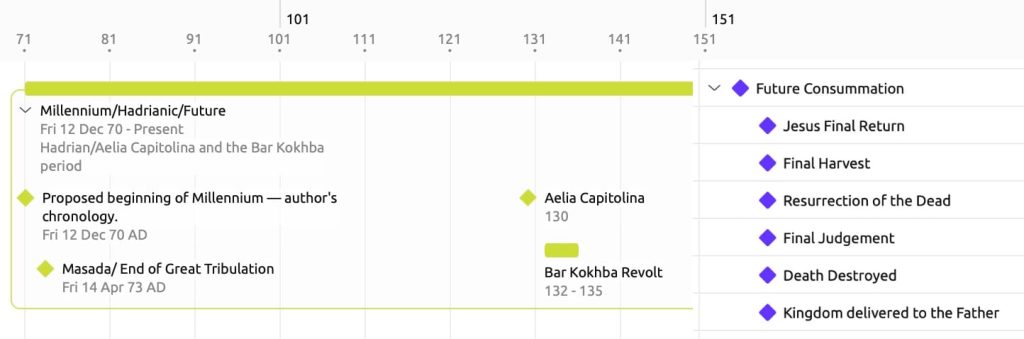
Millennium: 12 December 70 CE to Jesus’ final return,
and a Future Consummation
7. Question 2: What Will Be the Sign of Your Coming?
Immediately after the tribulation of those days the sun will be darkened, and the moon will not give its light; the stars will fall from heaven, and the powers of the heavens will be shaken. Then the sign of the Son of Man will appear in heaven, and then all the tribes of the earth will mourn, and they will see the Son of Man coming on the clouds of heaven with power and great glory.
Matthew 24:29-30
A. The Sign of the Son of Man
It is essential to distinguish this coming of the Son of Man from Jesus’ future final return for His glorious Bride. Matthew 24:30 says that they would see the Son of Man “coming” (erchomenon, from erchomai) on the clouds of heaven with power and great glory. Jesus had already declared that “all these things” would occur within that generation.
As we saw in our lesson Jesus’ Comings, Scripture describes several comings, or visitations, of Jesus and does not restrict every reference to His final return. Here, Jesus is describing His coming in judgment upon Jerusalem within the generation to whom He was speaking.
Jesus’ language also draws directly upon Daniel’s vision of the Son of Man:
“I was watching in the night visions,
Daniel 7:13-14
And behold, One like the Son of Man,
Coming with the clouds of heaven!
He came to the Ancient of Days,
And they brought Him near before Him.
Then to Him was given dominion and glory and a kingdom,
That all peoples, nations, and languages should serve Him.
His dominion is an everlasting dominion,
Which shall not pass away,
And His kingdom the one
Which shall not be destroyed.
In Daniel’s vision, the Son of Man comes with the clouds to the Ancient of Days and receives dominion, glory and a Kingdom. Jesus’ use of this imagery therefore does not require Him to be describing a physical descent from heaven to earth. It is royal and judicial language: the enthroned Son of Man exercises the authority of the Kingdom He has received.
B. 66 CE
In the chronology developed in our other lessons, the sign of the Son of Man occurred in 66 CE. The Jewish rebellion and Cestius Gallus’ campaign followed later in 66 year. In comparison, the Roman war proper began with Vespasian’s campaign in 67 CE and culminated in the destruction of Jerusalem in 70 CE. Thus, the judgment that followed the sign occurred within the generation Jesus had specified.
The phrase “after the tribulation of those days” must be understood within the sequence Jesus is describing and should not automatically be equated with the entire 2,300-day Great Tribulation discussed in our other lessons. We examine this distinction more fully in Theology of Jesus’ Advents.
Josephus, Tacitus and Pseudo-Hegesippus preserve accounts of extraordinary signs associated with this period. In the interpretation developed in these lessons, these historical reports correspond to Jesus’ prophecy concerning the sign of the Son of Man.
The sign therefore concerns Jesus’ coming in royal authority and judgment upon Jerusalem; it should not be confused with His future final return.
Assuredly, I say to you, this generation will by no means pass away till all these things take place.
Matthew 24:34
The distinction is therefore important. The New Testament writers repeatedly describe their own period as “the last days.” Those last days belonged to the generation Jesus addressed and culminated in the judgment upon Jerusalem. As we examine later, the “end of the age” concerns the conclusion of the age in which Jesus and the apostles lived. This must be distinguished from the future Final Harvest, resurrection of the dead, destruction of death, and the ultimate consummation of Christ’s Kingdom.
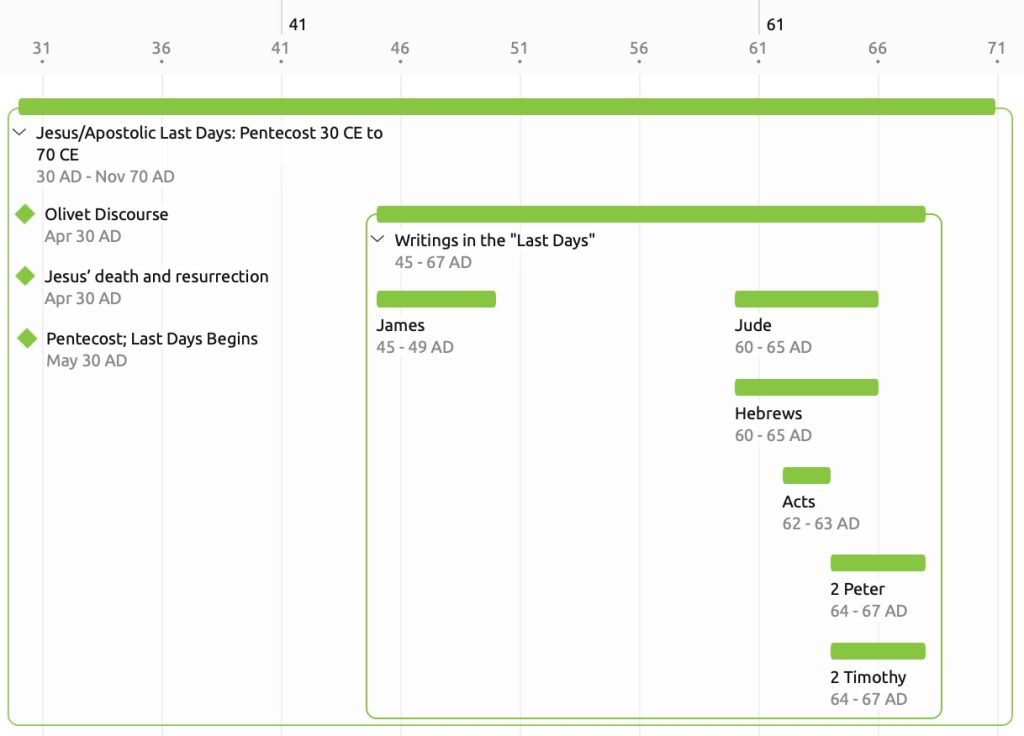
8. The Last Days
The New Testament writers repeatedly describe the period they were living in as “the last days.” They did not speak of the last days only as a period thousands of years in their future.
A. Peter at Pentecost
‘And it shall come to pass in the last days, says God,
Acts 2:17
That I will pour out of My Spirit on all flesh;
Your sons and your daughters shall prophesy,
Your young men shall see visions,
And your old men shall dream dreams.
Peter applies Joel’s prophecy concerning the “last days” to the events of Pentecost. The last days were therefore already underway in 30 CE, within the generation to whom Jesus had given His prophecy.
B. Paul:
Paul, writing to Timothy in the first century, describes the perilous conditions of the “last days” and instructs Timothy to turn away from people who display these characteristics.
But know this, that in the last days perilous times will come: For men will be lovers of themselves, lovers of money, boasters, proud, blasphemers, disobedient to parents, unthankful, unholy, unloving, unforgiving, slanderers, without self-control, brutal, despisers of good, traitors, headstrong, haughty, lovers of pleasure rather than lovers of God, having a form of godliness but denying its power. And from such people turn away!
2 Timothy 3:1-5
He then warns Timothy that “in the last days perilous times will come,” but his warning is not detached from Timothy’s own lifetime. After describing these people, Paul instructs Timothy, “And from such people turn away!” The last-days conditions Paul describes were therefore already relevant to Timothy and the churches he served.
C. Hebrews
The opening of Hebrews is even more explicit. The writer contrasts God’s former revelation through the prophets with what God had now done through His Son:
God, who at various times and in various ways spoke in time past to the fathers by the prophets, has in these last days spoken to us by His Son, whom He has appointed heir of all things, through whom also He made the worlds;
Hebrews 1:1-2
The writer does not say that the last days would begin in the distant future. He says that God “has in these last days spoken to us by His Son.” The writer and his first-century readers were therefore already living in what he called “these last days.”
D. Peter and Jude
Peter warned his readers that scoffers would come in the last days:
2 Peter 3:3-4
2 Peter 3:3
Knowing this first: that scoffers will come in the last days, walking according to their own lusts, and saying, “Where is the promise of His coming? For since the fathers fell asleep, all things continue as they were from the beginning of creation.”
Jude recalls the same apostolic warning and applies it directly to the circumstances confronting his readers:
But you, beloved, remember the words which were spoken before by the apostles of our Lord Jesus Christ: how they told you that there would be mockers in the last time who would walk according to their own ungodly lusts. These are sensual persons, who cause divisions, not having the Spirit.
Jude 17-19
Peter had warned that scoffers would come “in the last days,” while Jude reminded his readers that the apostles had warned them about mockers “in the last time.” Jude then immediately refers to such people in his own setting. This further shows that the apostolic warnings about the last days were relevant to the first-century Church, rather than referring exclusively to a period thousands of years in the future.
E. James
James speaks even more directly to wealthy people living in his own day:
Your gold and silver are corroded, and their corrosion will be a witness against you and will eat your flesh like fire. You have heaped up treasure in the last days.
James 5:3
He does not say that these people would live thousands of years later. He tells his own readers, “You have heaped up treasure in the last days.” The language places his contemporary audience within those last days.
Taken together, these passages establish an important New Testament pattern. Peter applied Joel’s “last days” prophecy to Pentecost; Hebrews says that God had spoken “in these last days” through His Son; Paul warned Timothy about conditions associated with the last days within his own ministry; and James told his contemporaries that they had accumulated wealth “in the last days.”
Within the interpretation developed in this lesson, this language corresponds with Jesus’ declaration that “all these things” would occur within His generation. The apostolic period was therefore not merely anticipating the Last Days—it was living in them.
9. Question 3: And of the End of the Age?
Heaven and earth will pass away, but My words will by no means pass away.
Matthew 24:35-36
“But of that day and hour no one knows, not even the angels of heaven, but My Father only.
Jesus now shifts the emphasis. He has just declared that “this generation will by no means pass away till all these things take place.” He then contrasts this with “that day and hour,” whose timing only the Father knows. Matthew introduces verse 36 with the Greek peri de, meaning “but concerning” or “now concerning.” This indicates a transition in the discussion, though it does not necessarily mean every statement after verse 36 refers exclusively to the End of the Age.
Jesus therefore moves from “all these things,” which He said would occur within that generation, to events whose precise timing He did not reveal. The following teaching must consequently be interpreted according to its own context rather than assuming that everything from Matthew 24:36 onward belongs to one event.
The parables and warnings that follow contain principles of watchfulness and judgment that must be examined individually. Some of their imagery may arise directly from the first-century world in which Jesus and His disciples lived. They should not automatically be transferred to the final judgment merely because they occur after Matthew 24:36.
The expression peri de (“but concerning”) marks a transition in Jesus’ discourse. It does not, by itself, establish how far in time the following subject is removed from the preceding events. That must be determined from the context.
A. An Example – “Cut Him in Two”
And will cut him in two and appoint him his portion with the hypocrites. There shall be weeping and gnashing of teeth.
Matthew 24:51
An example of the danger of automatically applying everything after Matthew 24:36 to God’s final judgment is Jesus’ statement that the unfaithful servant would be “cut in two.” If we interpret this as something God will literally do to people at the End of the Age, it presents a picture contrary to the nature and goodness of God revealed throughout Scripture and examined in our other lessons.
In the historical setting of Jesus’ prophecy, cutting people in two was a known form of human cruelty. Caligula provides a striking first-century example, with Suetonius recording that he had people “sawn asunder” (Caligula 27.3). Jesus elsewhere repeatedly described the hostile Jewish leadership and generation in severe terms, including as an “evil and adulterous generation.” In this context, His warning concerning the “evil servant” fits the same first-century setting. The imagery therefore does not require us to conclude that God will literally cut unbelievers in two at the final judgment.
Caligula provides an example from the first-century Roman world. The imagery therefore does not require us to conclude that God will literally cut unbelievers in two at the final judgment.
Jesus could use the familiar brutality of earthly rulers to warn His hearers of judgment without attributing that brutality to the character of His Father. As we have seen in our lessons concerning the nature of God, His judgments must be understood consistently with who He has revealed Himself to be. God’s response to humanity may change with repentance, rebellion, and relationship, but His nature and goodness do not.
Matthew 24:36 is therefore not a rigid dividing line placing everything that follows in the future Final Harvest; each passage must be read in its own context.
10. The End of the Age and the Final Harvest
A. What is an Age?
The Greek word translated “age” is aiōn (αἰών). It refers to an age, era or period of time. It is not the Greek word for “generation,” nor does it necessarily refer to the physical world or the end of human existence.
When Jesus spoke of “this age,” He meant the age in which He and His disciples were living. That age was already approaching its conclusion. Jesus Himself distinguished between “this age” and another age:
“Anyone who speaks a word against the Son of Man, it will be forgiven him; but whoever speaks against the Holy Spirit, it will not be forgiven him, either in this age or in the age to come.”
Matthew 12:32
Again, when discussing the resurrection, Jesus said:
Jesus answered and said to them, “The sons of this age marry and are given in marriage. But those who are counted worthy to attain that age, and the resurrection from the dead, neither marry nor are given in marriage;
Luke 20:34-35
Jesus therefore distinguished “this age,” in which He and His disciples were living, from another age. However, the expression “the age to come” or “that age” must be interpreted in context. In Luke 20, “that age” is specifically associated with the resurrection from the dead. What is clear is that an “age” is not necessarily synonymous with the physical world. When Scripture speaks of “the end of the age,” we must determine which age it means.
B. Paul Also Spoke of “This Age”
“However, we speak wisdom among those who are mature, yet not the wisdom of this age, nor of the rulers of this age, who are coming to nothing. But we speak the wisdom of God in a mystery, the hidden wisdom which God ordained before the ages for our glory, which none of the rulers of this age knew; for had they known, they would not have crucified the Lord of glory.”
1 Corinthians 2:6-8
Paul identifies those involved in the crucifixion of Jesus as “the rulers of this age.” His statement is therefore firmly anchored in the first-century world. Significantly, he says that the rulers of this age “are coming to nothing. Paul makes an even stronger statement later in the same epistle:
“Now all these things happened to them as examples, and they were written for our admonition, upon whom the ends of the ages have come.”
1 Corinthians 10:11
Paul does not place the “ends of the ages” thousands of years into the future. He tells the Corinthian believers that “the ends of the ages have come” upon them. They understood themselves as living in a decisive transition between ages.
C. Do Not Be Conformed to “This Age”
The same expression occurs in Romans, although the English translation obscures its significance:
“And do not be conformed to this world, but be transformed by the renewing of your mind, that you may prove what is that good and acceptable and perfect will of God.”
Romans 12:2
The NKJV translates the phrase as “this world,” but the Greek is tō aiōni toutō (τῷ αἰῶνι τούτῳ), literally “this age.” Paul was telling the Roman Christians not to conform themselves to the age in which they were living. He similarly writes:
“whose minds the god of this age has blinded, who do not believe…”
2 Corinthians 4:4
Again, Paul speaks of a distinct “age” in which he and his readers lived.
D. “This Age” and “The Age to Come”
Paul explicitly distinguishes the age in which he was living from the age that was to follow:
“…which He worked in Christ when He raised Him from the dead and seated Him at His right hand in the heavenly places, far above all principality and power and might and dominion, and every name that is named, not only in this age but also in that which is to come.”
Ephesians 1:20-21
This corresponds with Jesus’ distinction between “this age” and an age to come. The precise character of the coming age depends on the context of each passage. What is clear is that an age is not synonymous with the physical earth. The end of an age describes the conclusion of a period rather than necessarily the end of human history.
E. The End of “This Age”
Jesus and Paul both spoke from within “this age.” Paul described those associated with Jesus’ crucifixion as “the rulers of this age” and told the Corinthians that “the ends of the ages” had already come upon them.
As we have seen throughout this lesson, Jesus placed the events of His Last Days prophecy within the generation to whom He was speaking:
“Assuredly, I say to you, this generation will by no means pass away till all these things take place.”
Matthew 24:34
The New Covenant was established through Jesus’ death and resurrection in 30 CE.
Nevertheless, the Temple, Levitical priesthood and sacrificial system continued to function for another forty years. In 70 CE, the Temple was destroyed, and its sacrificial system disappeared.
In the interpretation developed in these lessons, this was the historical termination of “this age” of which Jesus and the New Testament writers spoke. The age in which Jesus had been crucified, whose rulers Paul said were “coming to nothing,” was passing away.
The “end of the age” should therefore not be automatically interpreted as the end of the world or of human history.
F. The Harvest at the End of the Age
This understanding is important when reading Jesus’ parables:
The enemy who sowed them is the devil; the harvest is the end of the age, and the reapers are the angels; therefore, as the tares are gathered and burned in the fire, so it will be at the end of this age.
Matthew 13:39-40
Jesus specifically identifies the harvest with “the end of the age.” Since Jesus spoke during “this age,” which we have identified as the age then drawing to a close, we should first examine this harvest in relation to the end of that age rather than automatically transferring it to the end of human history.
If Jesus was speaking about “this age,” the age in which He and His disciples were then living, we should not automatically move the fulfilment thousands of years into the future. The expression must first be understood within the first-century context in which Jesus used it.
G. “Even to the End of the Age”
Jesus uses the expression again in His Great Commission:
“Go therefore and make disciples of all the nations, baptising them in the name of the Father and of the Son and of the Holy Spirit, teaching them to observe all things that I have commanded you; and lo, I am with you always, even to the end of the age.”
Matthew 28:19-20
This statement was originally addressed to Jesus’ first-century disciples. If “the age” refers to an age approaching its conclusion, the phrase “to the end of the age” should be understood in that historical setting rather than automatically equated with the end of human history.
This does not mean that Jesus ceased to be with His Church after 70 CE. It means that this particular statement must be interpreted according to the meaning of “the age” in its original context. The New Testament establishes Christ’s continuing presence and reign throughout.
H. The End of an Age is Not the End of the World
The distinction is therefore important. The disciples asked Jesus about “the end of the age,” not simply about the destruction of planet Earth.
Jesus and Paul spoke of “this age.” Jesus contrasted it with “the age to come.” Paul said that the rulers of “this age” had crucified Jesus and were “coming to nothing.” He also told first-century Christians that “the ends of the ages” had come upon them.
In this lesson’s interpretation, “this age” was the age in which Jesus and the apostles lived, ending historically with the destruction of Jerusalem and the Temple in 70 CE. The End of the Age must therefore be distinguished from the future consummation of Christ’s Kingdom and the final destruction of death.
I. The Final Harvest
The end of “this age” in 70 CE should not be confused with the Final Harvest. Although one age ended with the judgment upon Jerusalem, Scripture looks beyond that event to the resurrection of the dead and the ultimate judgment of humanity. Jesus said:
“Do not marvel at this; for the hour is coming in which all who are in the graves will hear His voice and come forth – those who have done good, to the resurrection of life, and those who have done evil, to the resurrection of condemnation.”
John 5:28-29
This is more than the national judgment that came upon Jerusalem. Jesus specifically describes those who are in the graves coming forth. Therefore, a future resurrection and judgment remain beyond the events of 70 CE.
The imagery of judgment must likewise be interpreted from Scripture, not through the later traditional doctrine of eternal conscious torment. Fire repeatedly represents destruction and judgment. As examined in our other lessons, immortality is not inherent in humanity but is God’s gift through Christ. The final consequence of sin is death, not an immortal existence sustained eternally in torment.
Revelation describes this Final Harvest in terms of the resurrection and judgment of the dead:
“And I saw the dead, small and great, standing before God, and books were opened. Another book was opened, the Book of Life. And the dead were judged according to their works, by the things which were written in the books. The sea gave up the dead who were in it, and Death and Hades delivered up the dead who were in them. And they were judged, each one according to his works. Then Death and Hades were cast into the lake of fire. This is the second death.”
Revelation 20:12-14
The outcome is described as “the second death.” Immortality is God’s gift through Christ; it is not an inherent possession of every human being. The Final Harvest therefore brings life to those who belong to Christ and final death to those who do not.
J. The Kingdom Returned to the Father
The Final Harvest is followed by the ultimate consummation of Christ’s reign. Paul sets out the sequence clearly:
“For as in Adam all die, even so in Christ all shall be made alive. But each one in his own order: Christ the firstfruits, afterwards those who are Christ’s at His coming. Then comes the end, when He delivers the kingdom to God the Father, when He puts an end to all rule and all authority, and power, for He must reign till He has put all enemies under His feet. The last enemy that will be destroyed is death.”
1 Corinthians 15:22-26
Paul does not say that Christ begins to reign at this point. He says, “He must reign till” every enemy has been placed under His feet. Christ is already reigning, and His reign continues until He has accomplished His purpose.
The resurrection of those who belong to Christ is followed by “the end.” At this time the last enemy, death itself, is destroyed, and Jesus delivers the Kingdom to God the Father.
Paul continues:
“Now when all things are made subject to Him, then the Son Himself will also be subject to Him who put all things under Him, that God may be all in all.”
1 Corinthians 15:28
This is the Kingdom’s ultimate destination. Jesus received the Kingdom and reigns until He has subjected every enemy to Him. At the Final Harvest, death itself is finally destroyed. The Kingdom is then delivered to the Father, “that God may be all in all.”
K. Two Different Ends
The New Testament therefore describes two different conclusions which should not be confused. The “end of this age” refers to the age in which Jesus and the apostles lived, culminating in 70 CE.
The Final Harvest lies beyond that event and brings Christ’s reign to its ultimate consummation: the dead are raised, the last enemy – death – is destroyed, and the Kingdom is delivered to the Father.
End of “this age” -> 70 CE
Christ continues to reign -> Kingdom/Millennium
Final Harvest -> resurrection and judgment
Death destroyed -> “then comes the end”
Kingdom delivered to the Father -> “God may be all in all“.
11. Futurist Interpretations
Futurist interpretations generally understand substantial portions of biblical prophecy, particularly Matthew 24 and Revelation, as awaiting fulfilment in events associated with Jesus’ future return. However, futurists do not all interpret these passages in the same way.
Some are dispensational premillennialists, others are historic premillennialists, and futurist elements may also occur within other eschatological systems. Futurism should therefore not automatically be equated with either dispensationalism or cessationism.
A. Matthew 24 and the Future
“Assuredly, I say to you, all these things will come upon this generation.”
Matthew 23:36
He later said:
“Assuredly, I say to you, this generation will by no means pass away till all these things take place.”
Matthew 24:34
The interpretation presented here therefore understands “all these things” within these boundaries as applying to the generation Jesus was addressing. The destruction of Jerusalem and the Temple in 70 CE provides the primary historical culmination of this prophecy.
B. Futurism and Dispensationalism Are Not the Same
Dispensationalism is a particular theological system and should not be treated as synonymous with futurism. Modern dispensationalism developed principally through John Nelson Darby during the nineteenth century and was subsequently developed and popularised by others, particularly through the Scofield Reference Bible, first published in 1909.
Darby’s system drew a sharp distinction between Israel and the Church, which became foundational to dispensational eschatology, and outlined a specific sequence involving the Rapture, Tribulation, Christ’s return, and the Millennium.
However, belief in Jesus’ future return, resurrection, and judgment predates dispensationalism. Likewise, early Christian writers held premillennial expectations centuries before Darby.
C. Futurism Before Darby and Post-Tribulation Millennialism
Darby’s nineteenth-century contribution was the development and spread of a distinctive dispensational system, not the invention of belief in a future return of Jesus, resurrection, judgment or a millennial reign. Early Christian eschatology was itself diverse. Several early writers held forms of millenarian or chiliastic expectation, including Justin, Irenaeus, Tertullian and Hippolytus. It would therefore be historically inaccurate either to claim that premillennial expectation began with Darby or that all the Church Fathers held the same eschatological position.
In an important respect, the interpretation developed in these lessons agrees with post-tribulational millennialism: the Tribulation precedes the Millennium. Our disagreement concerns the dating of the Tribulation. We understand Jesus’ Great Tribulation prophecy as referring to the first-century judgment upon Jerusalem, occurring within the generation to whom He spoke, rather than to a future seven-year period immediately preceding His final return.
Jesus had already established His Kingdom and begun reigning before these events. Following the Great Tribulation and the destruction of Jerusalem, the millennial phase of Christ’s already-established reign began. The Millennium therefore does not await a future Great Tribulation; the tribulational events Jesus predicted occurred within the first-century timeframe He Himself gave.
This distinguishes our position both from dispensational pre-tribulationism and from futurist post-tribulationism. We agree with the post-tribulational sequence – Tribulation followed by Millennium – while identifying the Tribulation with the first-century events surrounding Jerusalem rather than with events immediately preceding Jesus’ future final return.
The future return of Jesus, resurrection of the dead, Final Harvest, destruction of death and ultimate delivery of the Kingdom to the Father remain future. They should not be confused with either the first-century Great Tribulation or the beginning of the millennial phase of Christ’s reign.
D. Why This Lesson Takes a Different View
This lesson’s interpretation begins with the chronological boundaries Jesus Himself gave. He declared that “all these things” would come upon “this generation” and that “this generation will by no means pass away till all these things take place.” The New Testament writers subsequently described themselves as living in the “last days,” while Paul said that “the ends of the ages” had come upon his first-century readers.
We therefore understand the Great Tribulation and the judgment described in Jesus’ Last Days prophecy as first-century events. They culminated in the destruction of Jerusalem and the Temple in 70 CE, within the generation Jesus had specified. In this respect, we retain the post-tribulational sequence discussed above: the Tribulation precedes the Millennium. Our difference from futurist post-tribulational interpretations concerns the timing of those events, not their order.
Christ’s Kingdom had already been established, and He was already reigning before the destruction of Jerusalem. The Millennium is a subsequent phase of that already-established reign, beginning after the Great Tribulation and the destruction of Jerusalem. We therefore do not await another Great Tribulation before the Millennium.
This does not mean that every biblical prophecy was fulfilled in 70 CE. Jesus’ future final return, the resurrection of the dead, the Final Harvest, the destruction of death and the ultimate consummation of Christ’s reign remain future. The end of “this age” in the first century must therefore be distinguished from “the end” Paul describes, when the last enemy, death, is destroyed and Christ delivers the Kingdom to the Father.
12. Summary of the Last Days Prophecy by Jesus
Jesus placed a clear chronological boundary around His Last Days prophecy.
A. Last days
In Matthew 23:36, He declared that “all these things” would come upon “this generation,” and in Matthew 24:34 He again stated that “this generation will by no means pass away till all these things take place.”
The primary fulfilment occurred within forty years. Jesus gave the prophecy around 30 CE, and Jerusalem and the Temple were destroyed in 70 CE, corresponding with the biblical precedent of the forty-year wilderness generation.
The New Testament writers understood themselves to be living in the Last Days. Peter applied Joel’s prophecy to Pentecost; Hebrews says God spoke “in these last days” through His Son; James told his contemporaries that they had accumulated wealth “in the last days”; and Paul wrote that “the ends of the ages” had come upon the first-century Church. The Last Days therefore belonged to the apostolic period and culminated in the judgment upon Jerusalem and the destruction of the Temple in 70 CE.
The Hadrianic events beginning around 130 CE provide a secondary correspondence with the four-hundred-years/four-generations pattern of Genesis 15, but they are not required to fulfil Jesus’ statement concerning “this generation.” The primary fulfilment had already occurred in 70 CE.
Jesus and Paul distinguished “this age” from a future age. Paul spoke of “the rulers of this age” who crucified Jesus and said that “the ends of the ages” had come upon his readers. In the interpretation developed in this lesson, 70 CE marked the historical conclusion of the age in which Jesus and the apostles lived.
B. Great Tribulation
The Great Tribulation also fits within this first-century framework. The Tribulation precedes the Millennium, but occurred within the generation Jesus addressed. Christ’s Kingdom was already established, and the Millennium is a subsequent phase of His reign following the Great Tribulation and the destruction of Jerusalem.
C. Future Consummation
This does not mean that all prophecy was fulfilled in 70 CE. Scripture still looks forward to Jesus’ future final Advent and the Final Harvest: the resurrection of the dead, final judgment and the ultimate destruction of death.
“Then comes the end, when He delivers the kingdom to God the Father, when He puts an end to all rule and all authority and power, for He must reign till He has put all enemies under His feet. The last enemy that will be destroyed is death.”
1 Corinthians 15:24-26
The conclusion of “this age” in 70 CE must therefore be distinguished from the “the end” Paul describes. At the Final Harvest, death itself is destroyed, and Christ delivers the Kingdom to the Father, “that God may be all in all” (1 Corinthians 15:28).
This interpretation allows Jesus’ one-generation prophecy to retain its natural first-century timeframe without denying the future resurrection, Final Harvest or consummation of the Kingdom.
© Use by Permission Awakening Impact Ministries/Dr Neville Westerbeek van Eerten D. Miss. 2027



Thanks very much for such a great teaching. It’s a great and deeper revelation that took me far in the word of God. May God continue using and blessing you.
I encourage you to go through all the videos on the study of eschatology