



Video Link at the Bottom of the Page
1. Understanding the Millennium in Revelation 20
What are the thousand years in Revelation 20, and when did they begin? Christ began to reign at His ascension. We understand the Millennium as a later phase of that reign, beginning in December 70 CE after Jerusalem’s destruction. This lesson explains why we read the thousand years symbolically and what it means for believers to reign with Christ today.
Jesus established His Kingdom through His resurrection and enthronement. We examine the millennial phase of that reign following Jerusalem’s destruction in 70 CE, while affirming His future bodily return, the resurrection of the dead and final judgment.
Christ’s kingship began at His ascension. The Millennium describes a subsequent phase of His already-established reign. This lesson examines that distinction, explains AIM’s understanding of the thousand years and considers the church’s calling to live faithfully under Christ’s authority.
A. Understanding the Different Views
Christians have understood the Millennium in several ways. Premillennial interpretations place Christ’s future final bodily return before a future millennial reign. Dispensational premillennialism develops this expectation within a particular understanding of Israel, the church and prophetic history. It should be distinguished from earlier forms of premillennial belief.
Amillennial interpretations generally understand the thousand years symbolically in relation to Christ’s present reign.
Postmillennial interpretations anticipate the extensive advance of Christ’s kingdom before His future final bodily return. Each broad category includes differences concerning the interpretation and sequence of particular passages.
Realised millennialism understands the Millennium as a present reality rather than an entirely future reign. AIM holds to this view, identifying the Millennium as a phase of Christ’s already-established reign following Jerusalem’s first-century judgment. AIM understands that we are still living in the Millennium, with Christ’s final bodily return remaining in the future.
Agreement with another interpretation on one point does not imply agreement with its entire framework. The argument must therefore rest on careful exposition of Scripture, supported by accurately presented historical evidence.
B. Christ Already Reigns
This Jesus God has raised up, of which we are all witnesses. Therefore being exalted to the right hand of God, and having received from the Father the promise of the Holy Spirit, He poured out this which you now see and hear.
Acts 2:32–36 (NKJV)
For David did not ascend into the heavens, but he says himself:
‘The LORD said to my Lord,
“Sit at My right hand,
Till I make Your enemies Your footstool.”‘
Therefore let all the house of Israel know assuredly that God has made this Jesus, whom you crucified, both Lord and Christ.
Peter proclaimed Jesus’ exaltation as an accomplished reality. The risen Christ had received the promised Holy Spirit from the Father and poured Him out upon His people. His authority did not await a future earthly enthronement.
His enemies’ subjection unfolds under that established authority. We must therefore distinguish the beginning of Christ’s kingship from the particular phase of His reign described in Revelation 20. Believers serve a reigning Lord while awaiting the completion of His victorious work.
C. AIM’s Understanding of the Millennium
The following conclusions guide this lesson:
- Christ’s reign began at His ascension. The Millennium does not mark the beginning of His kingship.
- The thousand years describe a real period through a symbolic number. This interpretation requires examination of Revelation’s context and imagery; examples of symbolic numbers elsewhere in Scripture do not establish it by themselves.
- The millennial transition follows Jerusalem’s destruction. AIM’s adopted chronology places this transition on 12 December 70 CE, based on its interpretation of Daniel’s 1,335 days. This precise date is a chronological reconstruction, not a date explicitly supplied in Revelation.
- The transition is distinct from the end of the wider calculated Great Tribulation. AIM places that wider period between 23 December 66 CE and 10 April 73 CE. The lesson explains why the millennial transition is placed within that span, after Jerusalem’s devastating judgment.
- We are still living in the Millennium. Believers presently participate in Christ’s reign, while awaiting the events that bring this phase to its conclusion.
- The Final Consummation remains in the future. Christ’s final bodily return, the resurrection and final judgment must not be confused with His first-century coming in judgment against Jerusalem.
- Gog and Magog represent the nations of the earth gathered in rebellion. Revelation 20:8 identifies them with the nations in the four corners of the earth. AIM does not assign these names to particular modern countries.
D. The Purpose of This Study
This lesson moves from the biblical use of a thousand to the sequence and imagery of Revelation 20. It then examines the historical and prophetic basis for AIM’s millennial chronology, the meaning of reigning with Christ, and the events associated with the Millennium’s conclusion.
The first-century setting of fulfilled prophecy must remain distinct from the church’s future hope. We must also distinguish historical records from chronological reconstructions and theological interpretations.
Our purpose is to understand Scripture faithfully and live confidently under Christ’s present authority. That confidence expresses itself through prayer, holiness, compassionate service, faithful witness and dependence upon the Holy Spirit. Christian hope rests upon Christ, who reigns now and will come bodily at the Final Consummation.
2. The Old Testament Background to the Thousand Years
The Old Testament demonstrates that “a thousand” does not always function as an exact numerical limit. In poetic passages, it can express the greatness of God’s possessions, the enduring nature of His covenant, and the contrast between human experience and His eternal existence. We should therefore consider the context before assuming that Revelation’s thousand years must represent precisely one thousand calendar years.
A. The Cattle on a Thousand Hills
For every beast of the forest is Mine
Psalms 50:10-11
And the cattle on a thousand hills.
I know all the birds of the mountains,
And the wild beasts of the field are Mine.
God is not claiming ownership of the cattle on only one thousand hills. The surrounding verses declare His ownership of the birds, the wild animals, and the whole world. The thousand hills express the vastness of His possessions; they do not mark the boundary of His ownership.
This establishes an important principle: a definite number can communicate a truth that extends beyond its literal numerical value.
B. His Covenant for a Thousand Generations
Remember His covenant forever,
1 Chronicles 16:15-17 (NKJV)
The word which He commanded, for a thousand generations,
The covenant which He made with Abraham,
And His oath to Isaac,
And confirmed it to Jacob for a statute,
To Israel for an everlasting covenant,
The passage places “a thousand generations” alongside “forever.” Verse 17 then describes the same covenant as everlasting. Read together, these expressions emphasise God’s enduring covenant faithfulness. The passage does not suggest that His faithfulness expires when the thousandth generation has passed.
The number therefore serves the covenant promise. Turning it into a calculation of forty thousand or one hundred thousand years would miss the passage’s emphasis and would not establish a date for Christ’s return.
C. A Thousand Years Compared with Yesterday
Lord, You have been our dwelling place in all generations.
Psalms 90:1-4 (NKJV)
Before the mountains were brought forth,
Or ever You had formed the earth and the world,
Even from everlasting to everlasting, You are God.
You turn man to destruction,
And say, “Return, O children of men.”
For a thousand years in Your sight
Are like yesterday when it is past,
And like a watch in the night.
The psalm contrasts God’s eternal existence with the brevity of human life. Against this background, a thousand years are compared with yesterday after it has passed and with a watch during the night.
These are poetic comparisons, not a mathematical conversion of divine time into human time. A whole day and a watch during the night are different lengths, yet both illustrate the same point: a span that seems immense to us is brief compared with God’s enduring existence.
This passage does not, by itself, prove that Revelation’s Millennium is symbolic. It demonstrates that the biblical expression “a thousand years” can serve a theological purpose without supplying a prophetic timetable.
D. What This Means for the Millennium
These passages provide a biblical precedent for understanding “a thousand” as an expression of magnitude or fullness rather than an exact numerical limit. Consequently, this number in Revelation does not settle the question of the Millennium’s duration.
Different passages also use numbers for different purposes. A poetic expression in a psalm cannot automatically determine a number’s meaning in Revelation. We must examine Revelation’s own language, imagery and context.
AIM understands the thousand years as a symbolic description of the extended millennial phase of Christ’s reign in which we are still living. The period is real and has a beginning and an end, but its symbolic designation does not require it to last exactly one thousand calendar years.
The Old Testament examples support this reading. The argument for applying it to the Millennium must now be developed from Revelation 20 and the wider biblical teaching concerning Christ’s reign.
3. The Thousand Years in Revelation
The term Millennium comes from Latin words meaning a thousand years. Revelation 20:1-7 uses the expression “a thousand years” six times in describing Satan’s binding, the reign of Christ’s people and Satan’s eventual release.
As established in the introduction, we understand the thousand years as a symbolic number describing a real, extended phase of Christ’s reign in which we still live. We now examine Satan’s binding and the church’s participation in Christ’s victory.
A. Satan Bound for a Thousand Years
Then I saw an angel coming down from heaven, having the key to the bottomless pit and a great chain in his hand. He laid hold of the dragon, that serpent of old, who is the Devil and Satan, and bound him for a thousand years; and he cast him into the bottomless pit, and shut him up, and set a seal on him, so that he should deceive the nations no more till the thousand years were finished. But after these things he must be released for a little while.
Revelation 20:1-3 (NKJV)
John describes spiritual realities through vivid imagery: a dragon, a key, a chain, a bottomless pit and a seal. The passage explicitly identifies the dragon as the Devil and Satan. The vision therefore requires interpretation rather than assuming every detail describes a physical object.
The key, chain and seal portray confinement under divine authority. Satan does not possess unrestricted freedom to determine the course of history. His restraint, subsequent release and final judgment remain subject to God’s authority.
Symbolic imagery does not make the restraint imaginary. The vision describes a real restriction on Satan’s activity through images that communicate confinement and the limitation of his power.
B. The Purpose of Satan’s Binding
Revelation states the purpose of Satan’s confinement: “so that he should deceive the nations no more till the thousand years were finished” (Revelation 20:3). This purpose must remain central to our interpretation.
The passage does not say that every manifestation of evil disappears during the Millennium. Satan’s binding should therefore not be understood as the complete absence of temptation, persecution, false teaching or human wickedness. His power is restrained, but believers still confront his works.
His eventual release reveals the contrast. Revelation 20:7-9 describes Satan going out to deceive the nations and gather them against God’s people. That final gathering remains in the future. It illustrates the significance of his restraint without reducing the whole meaning of the binding to the prevention of that battle alone.
Satan’s restraint provides the setting in which Christ’s people exercise their calling to rule and reign with Him. Ongoing spiritual conflict does not mean Christ’s reign has not begun or that the church must wait until His final bodily return to exercise spiritual authority.
C. Christ’s Victory Is the Foundation
Having disarmed principalities and powers, He made a public spectacle of them, triumphing over them in it.
Colossians 2:15 (NKJV)
Paul presents Christ’s triumph over principalities and powers as accomplished. The church does not create this victory through its own strength. Believers act upon what Christ has already achieved.
and raised us up together, and made us sit together in the heavenly places in Christ Jesus,
Ephesians 2:6 (NKJV)
Our position is in Christ. His people’s authority derives from their relationship with Him and their participation in His life. It is not independent power, nor does it make believers sovereign over God’s purposes.
Christ’s triumph through the cross and His exaltation preceded the millennial transition after Jerusalem’s destruction. The Millennium is a later phase in the outworking of His established reign, not the first time Christ or His disciples possessed authority over evil.
D. The Church Participates in His Victory
to the intent that now the manifold wisdom of God might be made known by the church to the principalities and powers in the heavenly places, according to the eternal purpose which He accomplished in Christ Jesus our Lord, in whom we have boldness and access with confidence through faith in Him.
Ephesians 3:10-12 (NKJV)
Paul emphasises that this purpose is at work now. The church makes God’s wisdom known to principalities and powers through its life in Christ. This calling belongs to believers’ present participation in His reign.
As explained in Fellowship of the Mystery of His Will, God’s sons and daughters are called to exercise spiritual authority through wisdom, faith and boldness. They grow in their practical exercise of that authority as they mature in their relationship with the Father and learn to obey Him.
During the Millennium, the church increasingly confronts and displaces the works of Satan through the gospel, prayer, holiness, faithful obedience, deliverance and the power of the Holy Spirit. This includes ministry through healings and miracles as God works through His people.
The distinction is between Christ’s established victory and the church’s growing participation in its outworking. His authority does not increase because believers become more mature. Rather, believers grow in their understanding and in faithfully exercising the authority He has given them.
E. Binding Satan’s Works
And I also say to you that you are Peter, and on this rock I will build My church, and the gates of Hades shall not prevail against it. And I will give you the keys of the kingdom of heaven, and whatever you bind on earth will be bound in heaven, and whatever you loose on earth will be loosed in heaven.
Matthew 16:18-19 (NKJV)
Jesus places the building of His church under His own authority. The promise concerning the gates of Hades gives His people confidence that the powers opposing His purpose will not ultimately prevail.
The church’s authority to bind and loose includes its calling to confront Satan’s works under Christ’s direction. As the church grows in kingdom authority and anointing, it increasingly brings the reality of Christ’s victory to bear upon the lives of people and communities.
Matthew 16 and Revelation 20 present different scenes. Matthew records Jesus’ promise concerning His church and the keys of the kingdom; Revelation depicts an angel confining Satan. We should not identify every detail of one passage with the other. Their connection is Christ’s supremacy and the effective restraint of the powers opposing His kingdom.
The church’s ministry does not replace the divine action portrayed in Revelation. It expresses believers’ participation in Christ’s reign during the period of restraint. Spiritual authority is exercised through dependence upon Him, not through confidence in a verbal formula or personal power.
F. A Symbolic Number Describing a Real Period
The Old Testament passages examined in Section 2 demonstrate that “a thousand” can express magnitude or fullness without imposing an exact numerical limit. Revelation’s visionary setting further supports considering whether the thousand years function symbolically.
Nevertheless, the presence of symbols does not automatically make every number symbolic. Nor does the repetition of a number automatically make it literal. Its meaning must be assessed within the passage as a whole.
The thousand years describe the extended period God appointed for this phase of Christ’s reign. The number communicates the fullness of that appointed period rather than providing a calendar calculation for Christ’s future final bodily return. This interpretation preserves the passage’s temporal distinctions. Satan is restrained during the Millennium, released after it and subsequently brought to final judgment. A symbolic duration does not erase that sequence.
G. The Millennium Has an End
Now when the thousand years have expired, Satan will be released from his prison.
Revelation 20:7 (NKJV)
The Millennium is not an endless period. Revelation describes its completion and what follows. We are still living in this millennial phase, with Satan’s final release and the gathering of Gog and Magog still in the future. We must not confuse the conclusion of this phase with Christ ceasing to possess authority. The Millennium describes a particular period within His reign; its completion belongs to the wider movement towards the Final Consummation.
The return of the Jewish people to Israel may signal that this millennial period is gradually drawing to a close. We consider this possibility alongside the biblical teaching concerning Israel’s gathering and recognition of Jesus as Messiah. These developments require careful examination and do not establish how soon Christ’s future final bodily return will occur. Section 8 explores their significance.
Revelation 20 does not supply a calendar date for the Millennium’s beginning or conclusion. The chronology adopted in this lesson places its beginning on 12 December 70 CE, for reasons developed later. This date is a reconstruction; the Millennium’s conclusion remains undated. Our present responsibility is to live faithfully under Christ’s authority and fulfil the work He has entrusted to His church.
4. Is the Millennium the Seventh Day of Rest?
Some interpretations arrange human history into seven thousand years: six thousand years corresponding to the six days of creation, followed by a thousand-year Sabbath. Christ’s future final bodily return is then placed at the beginning of this seventh millennium.
This proposal combines the creation week, Peter’s comparison of a day with a thousand years, and the reign described in Revelation 20. However, Scripture does not explicitly join these passages into a timetable. We must examine both the passages’ meaning and the chronology used to support the calculation.
A. The Seven-Thousand-Year Interpretation
The proposed pattern commonly allows approximately four thousand years from Adam to Christ, followed by two thousand years before Christ’s return. A further thousand years would complete the seventh period.
An early form of this interpretation appears in the Epistle of Barnabas, chapter 15. Its antiquity does not establish its biblical authority. Nor should we attribute it to every dispensationalist or every Christian who expects a future millennium. Our concern here is the particular claim that a six-thousand-year calculation can identify when Christ must return.
Even the apostles did not immediately understand everything Jesus taught. Luke records that they failed to understand the prediction of His suffering and resurrection (Luke 18:31-34). John likewise explains that the disciples understood certain things only after Jesus was glorified (John 12:16). Their understanding developed as Jesus opened the Scriptures to them and the Holy Spirit taught them (Luke 24:44-45; John 14:26).
This does not mean that their later teaching was unreliable. It shows that being close to Jesus did not mean understanding everything at once. Likewise, the early Christian writers deserve careful attention, but their proximity to the apostolic period does not make every interpretation correct. We must examine their expectations concerning the Tribulation and Millennium in light of Scripture. Justin himself acknowledged that faithful Christians differed from his millennial view.
Neither Genesis nor Revelation 20 explicitly instructs us to convert the creation days into successive thousand-year periods of human history.
B. One Day As One Thousand Years
But, beloved, do not forget this one thing, that with the Lord one day is as a thousand years, and a thousand years as one day.
2 Peter 3:8 (NKJV)
Peter makes a comparison in both directions. A day is as a thousand years, and a thousand years are as a day. He does not establish a fixed conversion by which every biblical day represents one thousand calendar years.
Psalm 90:4 similarly compares a thousand years in God’s sight with yesterday and with a watch in the night. These comparisons express the difference between God’s perspective and our experience of time.
Peter does not mention six creation days, a seventh millennium or a date for Christ’s return. Reading those elements into his words goes beyond what the passage itself establishes.
C. What Happens When We Count the Years?
Even if we adopt a continuous genealogical chronology for the sake of argument, the proposed timetable does not produce the result often claimed.
Our calculation begins with the Temple foundation in 966 BCE and works backwards through the Exodus, Jacob’s entry into Egypt, the patriarchal ages and the genealogies of Genesis 5 and 11. Under the assumptions explained in the accompanying schematic, Adam’s chronological starting point falls in 4173 BCE.
This is a calculation within a selected reading of the biblical chronology, not an independently established date for Adam’s creation. We can test the proposed timetable without treating Adam as a historically datable individual.
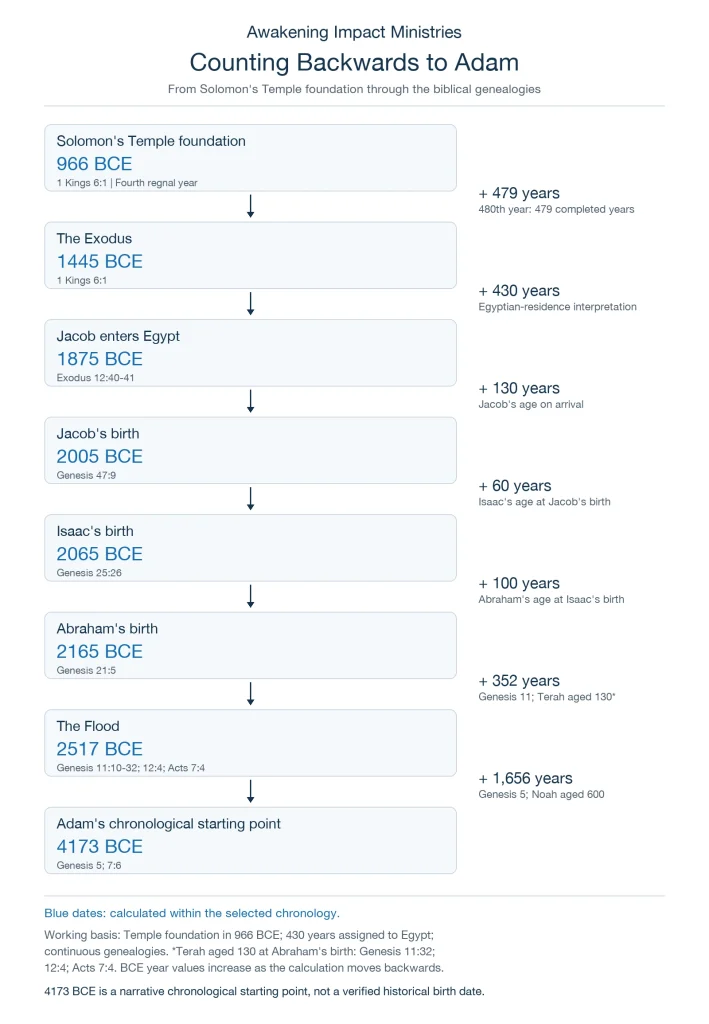
Assuming no year zero, 6,000 years from 4173 BCE brings us to about 1828 CE. By 2026 CE, about 6,198 years would have elapsed. By then, nearly two centuries would have passed since the proposed beginning of the seventh millennium.
The traditional Hebrew calendar gives a different result. In November 2026, the year is 5787, leaving approximately 213 years until year 6000. That boundary lies around 2239–2240 CE, depending on whether we mean entering year 6000 or completing six thousand years.
One framework therefore places the proposed transition in the past; the other places it more than two centuries in the future. Neither supports the claim that a simple biblical calculation establishes Christ’s return in our present generation.
This comparison does not mean that the entire seventh millennium has passed. It shows that its supposed starting date depends on the chronology chosen. It also exposes the weakness of treating Peter’s comparison as a precise prophetic clock.
D. God’s Patience and the Call to Repentance
The Lord is not slack concerning His promise, as some count slackness, but is longsuffering toward us, not willing that any should perish but that all should come to repentance.
2 Peter 3:9 (NKJV)
The following verse explains Peter’s concern. People must not mistake what they perceive as delay for God’s failure to keep His promise. His patience provides opportunity for repentance.
The passage calls us to trust God’s faithfulness and respond to His mercy. It gives no instruction to calculate six thousand years from Adam and announce a date for Christ’s return.
Within our realised-millennial understanding, Christ already reigns, while His future final bodily coming, the resurrection and the Final Consummation remain our hope. Their fulfilment does not depend upon identifying a seventh thousand-year period from creation. We await God’s fulfilment with faithfulness and perseverance, without assigning a date Scripture has not supplied.
E. The First Century Setting
Peter wrote to first-century believers, and his warning about scoffers must first be heard within their circumstances. The apostolic proclamation identified their own time with the last days.
But this is what was spoken by the prophet Joel:
Acts 2:16-17 (NKJV)
‘And it shall come to pass in the last days, says God,
The last days were already relevant to Peter’s hearers. Within the first-century framework developed in Jesus’ Last Days Prophecy, Jerusalem’s approaching judgment belongs to the conclusion of that apostolic period.
However, the date of a letter does not establish that every event it discusses occurred within its readers’ generation. Each reference to judgment or Christ’s coming must be examined in context. His first-century coming in judgment against Jerusalem must remain distinct from His future final bodily return.
For this argument, the essential point is straightforward: 2 Peter 3:8 gives no instruction to calculate six thousand years before Christ’s future final bodily return. That conclusion does not depend upon assigning every statement in the chapter to the same event.
F. The Rest Available to God’s People
Hebrews 4 approaches God’s rest through creation, Israel’s wilderness experience and the continuing invitation to respond in faith. The wilderness generation’s failure warns against unbelief, while God’s promise remains open to His people.
For we who have believed do enter that rest,
Hebrews 4:3, excerpt (NKJV)
There remains therefore a rest for the people of God.
Hebrews 4:9 (NKJV)
The passage connects entry into God’s rest with faith. It also calls readers to persevere rather than repeat the wilderness generation’s disobedience. Rest is presented as a promise demanding a response, not merely as a distant date on a prophetic calendar.
Hebrews draws upon God’s seventh-day rest, but it does not identify that rest as a literal thousand-year period beginning after six thousand years of history. Its invitation applies to the people being addressed. Believers do not need to wait for Christ’s future final bodily return to enter the rest available through Him.
Our separate lesson on Sabbath Rest develops this theme more fully. Here, the distinction is between the biblical invitation to enter God’s rest and the proposed chronological scheme built around a seventh millennium.
G. What This Establishes
The creation week, Psalm 90, 2 Peter 3, and Hebrews 4 contribute important truths about God’s work, His eternity, His patience, and the rest available to His people. They do not jointly provide an explicit seven-thousand-year timetable.
This does not settle every question concerning Revelation 20. It establishes that the duration and placement of the Millennium must be argued from the relevant passages, not assumed from a numerical pattern.
Christ reigns now, and His people are called to trust Him, enter His rest and participate faithfully in His purposes. The expectation of His future final bodily return strengthens that calling without supplying a date for its fulfilment.
5. Prelude to the Millennium
The Millennium follows the judgments described in the preceding visions of Revelation. Within the first-century interpretation developed in these lessons, those judgments concern the persecution of the church, the Roman campaign and the destruction of Jerusalem.
The following events provide the biblical and historical background to the millennial transition. Some are explicitly connected in Scripture; others are historical events identified with the prophetic imagery through interpretation. Keeping that distinction clear allows us to explain the argument without presenting every proposed correspondence as a statement made directly by the biblical writers.
A. Christ’s Coming in Judgment
We must distinguish the coming of Christ associated with Jerusalem’s judgment from His future final bodily return.
The Comings of Christ: His Reign, Judgment and Final Coming examines six occasions associated with His coming and manifestation:
- His birth.
- The commencement of His Ministry.
- Jesus’ transfiguration.
- His ascension and coronation.
- His coming judgment against Jerusalem.
- His future bodily return.
These events differ in their nature and purpose. Each passage must therefore be examined in context to determine which coming is intended.
Jesus told Caiaphas that he would see the Son of Man coming on the clouds of heaven. He also declared that the events of His prophecy would occur within that generation (Matthew 26:64; Matthew 24:34). We understand these statements as referring to His first-century vindication and coming in judgment.
Josephus reports chariots and armed troops appearing among the clouds before Jerusalem’s destruction. We associate this reported sign with the coming in judgment and date it, within the adopted reconstruction, to 21 May 67 CE. Josephus supplies the date of 21 Artemisius but does not explicitly supply the year in that passage; the year and Julian correlation belong to the chronological reconstruction.1
Christ was already King, having been enthroned at His ascension. The Millennium marks a subsequent phase of His reign. His future final bodily return, the resurrection and final judgment remain ahead.
B. The Persecuting Power and Nero
The visions preceding Revelation 20 describe opposition to Christ and persecution of His people. Our Antichrist lesson identifies Nero as the main imperial persecutor in this first-century setting.
“There are also seven kings. Five have fallen, one is, and the other has not yet come. And when he comes, he must continue a short time.”
Revelation 17:10 (NKJV)
The interpretation followed here counts the rulers from Julius Caesar: Julius Caesar, Augustus, Tiberius, Caligula, Claudius, Nero and Galba. On that reckoning, the first five had died, Nero was reigning, and Galba would follow for a short period.
This identification depends upon the starting point and method of counting. Revelation does not name these rulers individually. The proposed correspondence must therefore be considered alongside the other evidence developed in the Antichrist lesson.
The numerical value of the Hebrew spelling of Neron Caesar provides another connection to 666. Nero’s persecution of Christians supplies the historical setting for understanding the conflict between imperial power and those faithful to Jesus.
Nero died on 9 June 68 CE, before Jerusalem’s destruction and the millennial transition. His death belongs within this sequence, although it should not be taken to mean that all persecution or every expression of opposition to Christ immediately ceased.
John’s references to many antichrists and the spirit of the Antichrist likewise show that opposition to Christ was already present within the apostolic period (1 John 2:18; 4:3).
C. Abomination of Desolation
Jesus’ warning concerning the abomination of desolation gave His disciples a practical instruction: they were to flee rather than remain in the place approaching judgment.
But when you see Jerusalem surrounded by armies, then know that its desolation is near.
Luke 21:20 (NKJV)
Read alongside Matthew 24:15-20, Luke’s wording connects the warning with Jerusalem’s military encirclement. Our related teaching identifies the Roman armies as the instrument of desolation.
Cestius Gallus’ advance and withdrawal in late 66 CE must be distinguished from Vespasian’s and Titus’ subsequent campaigns. The initial withdrawal created the opportunity for the believers’ flight. The later campaigns brought the destruction towards which the warning pointed.
Within this interpretation, the holy place in the warning encompasses Jerusalem as the city set apart for God, rather than requiring the fulfilment to be restricted to an object placed inside the Temple.
The importance for the Millennium is the sequence: warning, opportunity to flee, judgment and the subsequent transition. These events concern Christ’s first-century coming in judgment against Jerusalem, not His future final bodily return.
D. Apostasy and False Teaching
Jesus warned that deception would accompany the approaching distress. False christs and false prophets would arise, while betrayal, lawlessness and the cooling of love would test His followers (Matthew 24:10-12, 23-26).
The apostolic letters show that false teaching was already troubling the churches. John’s discussion of those who departed from the community places this conflict within his readers’ own experience (1 John 2:18-19).
Our lesson on False Christs and Prophets examines these warnings and their first-century setting. Their relevance does not depend upon demonstrating that every later form of false teaching had already reached its fully developed form.
The essential point is that apostasy was not merely a distant possibility. The first churches faced serious departures from the gospel while the apostles were still ministering. Any proposed numerical estimate of those who fell away requires a separate argument; it should not be presented as a documented census of the early church.
E. Gospel Proclaimed Among the Nations
Jesus connected the proclamation of the gospel among the nations with the approaching end described in His discourse (Matthew 24:14).
The apostolic letters use expansive language concerning the gospel’s spread. Paul describes its fruitfulness throughout the world and its proclamation throughout creation under heaven (Colossians 1:6, 23). Romans 16:25-26 likewise connects the revelation of the gospel with its being made known to all nations.
These statements are important evidence for how the apostles understood the scope of the mission in their own time. They must be interpreted within the language and geographical horizon of their historical setting rather than automatically treated as a modern survey of every population group.
Within the framework of Jesus’ Last Days Prophecy, the proclamation required before Jerusalem’s judgment was fulfilled in the apostolic generation. This does not end the church’s missionary responsibility. The gospel continues to be proclaimed throughout the present Millennium, calling people from every nation into discipleship.
F. Famines, Pestilences and Earthquakes
Jesus included famines, pestilences and earthquakes as Last Days Proofs, among the troubles His disciples would encounter (Matthew 24:7). Our separate lesson examines the biblical and historical evidence for these events during the first-century generation.
We must understand their place in the prophecy alongside Jesus’ warning that such disturbances did not, by themselves, mean the end had arrived. They formed part of the developing circumstances rather than an independent way to calculate a date.
The same distinction remains important today. An earthquake, epidemic, or famine does not automatically establish that Christ’s future final bodily return is imminent. We must first identify the people addressed, the events described, and the timeframe the passage provides.
G. The Heifer Reported by Josephus
Some contemporary expectations of a future Temple focus heavily on the red heifer required in Numbers 19. That requirement belongs to the Old Covenant purification arrangements. Jesus does not state that the appearance of another red heifer will be a condition of His future final bodily return.
Josephus reports an unusual event involving a heifer brought for sacrifice, which he says gave birth to a lamb within the Temple precincts. He includes this among the signs preceding Jerusalem’s destruction. Our interpretation places these Passover signs in 67 CE.2
The report must be described accurately. Josephus does not identify the animal as a red heifer or explicitly connect the event with Numbers 19. Its inclusion among his reported signs does not, by itself, establish that that occurrence fulfilled the red-heifer ordinance.
The event can therefore be considered within the study of the signs preceding Jerusalem’s judgment, while the theological significance assigned to it remains distinct from what Josephus actually records.
H. Wars and Rumours of Wars
The apostolic generation experienced imperial campaigns, regional conflicts, civil war and violence between communities. Our lesson Wars and Rumours of Wars examines these events in detail.
Jesus’ warning concerns the conflicts His disciples would hear about and experience within the setting of His prophecy. Those wars culminated in the devastation of Jerusalem and its Temple.
The historical evidence demonstrates the severity of that period. Claims comparing its losses with other catastrophes require care concerning reported totals, population estimates and the length of time being compared. Such comparisons can illustrate the scale of suffering, but they do not form the basis of the prophetic interpretation.
For this argument, the central point is that warfare formed part of the first-century setting before the millennial transition. Modern conflicts should not automatically replace the events Jesus warned about.
I. Euphrates Army
Our lesson, Euphrates Army of Revelation, examines the four angels and the mounted army described in Revelation 9 within the setting of the Roman campaign against Jerusalem.
The interpretation distinguishes the spiritual powers portrayed in the vision from the human commanders and forces through whom they operated. The proposed correspondence concerns the four principal Roman legions involved in the siege: the Fifth, Tenth, Twelfth and Fifteenth.
Josephus connects the Roman forces with the Euphrates region. He records additional soldiers drawn from its guards and states that the Tenth Legion had previously been stationed beyond the river. These connections provide historical grounds for examining the imagery within the first-century campaign.3
The prophetic identification remains an interpretation of that evidence. It does not require turning the Tenth Legion into an army composed entirely of cavalry or treating Revelation’s immense number as a straightforward count of Roman soldiers.
The significance here is the gathering of forces to judge Jerusalem before the millennial transition.
J. Great Tribulation and its Chronology
The chronology adopted in these lessons places the calculated 2,300-day Great Tribulation between 23 December 66 CE and 10 April 73 CE, using Julian dates.
These dates require precise description. The starting point is calculated from the adopted endpoint; Josephus does not explicitly date Nero’s decision to commission the campaign to 23 December. At Masada, the chronology associates 10 April 73 CE with the deaths Josephus describes, with the Roman entry occurring the following morning. The year of Masada’s fall remains historically debated between 73 and 74 CE.
The millennial transition falls on the Jewish captives’ arrival at Antioch around 12 December 70 CE, after Jerusalem’s destruction but before the end of that wider calculated period. We must therefore avoid saying that every event associated with the Great Tribulation had ended before the Millennium began.
Section 6 develops the distinction between the climactic judgment upon Jerusalem, the shortening of its devastating effects and the endpoint represented by Masada.
K. The Forty-Two Months
Revelation 11:2 describes the holy city being trampled by the Gentiles for forty-two months. Our Forty-Two Month Prophecy lesson connects this period with Jerusalem’s first-century distress and identifies the Idumeans within its interpretation of the Gentiles.
The adopted chronology places the period between Passover in 67 CE and Jerusalem’s fall in September 70 CE. The month count must be understood within the calendar and counting method used in that study, rather than assumed to equal forty-two modern calendar months.
This period belongs within the wider Great Tribulation and precedes the proposed millennial transition. It should not be confused with the full 2,300-day span.
L. 144,000
Revelation 7 and 14 describe the company designated as the 144,000. Our related study identifies them with Jewish believers of the first century, gathered before and during the period of judgment.
Revelation presents them as belonging to God and the Lamb. Their significance concerns covenant identity, faithfulness and their place within the unfolding vision, rather than merely a population total.
The conclusion that the number of Jewish believers had reached or exceeded 144,000 by Jerusalem’s fall requires the evidence developed in that separate study. Revelation’s number should not be presented as though an independently surviving church census verifies it.
Within the interpretation followed here, this company belongs to the first-century setting leading towards the Millennium. This identification supports the broader argument that the visions concern events already approaching the original readers.
M. From Judgment to the Millennial Phase
These themes bring together the persecution of believers, the spread of the gospel, apostasy, military judgment and the preservation of God’s people. Their combined significance lies in the first-century setting established throughout the related lessons.
Christ’s coming in judgment against Jerusalem did not begin His kingship. He already reigned from His ascension. The question is how the completion of Jerusalem’s judgment relates to the next phase of that reign.
We now turn to the proposed transition in December 70 CE and examine why it is distinguished from the later endpoint of the wider Great Tribulation.
6. The Millennial Transition After Jerusalem’s Judgment
Jerusalem’s destruction in 70 CE marks the decisive judgment around which the preceding sections have been organised. The question now is why the Millennium is placed in December of that year when the wider calculated Great Tribulation continues until April 73 CE.
The distinction concerns the completion of Jerusalem’s climactic judgment and the continuation of the wider conflict. The millennial transition does not require every Roman military operation to have ended. It marks a subsequent phase of Christ’s already-established reign following the judgment upon Jerusalem.
The chronology adopted here identifies this transition with 12 December 70 CE, in connection with Daniel’s 1,335-day prophecy and the reconstructed arrival of Jerusalem captives at Antioch. The precise date and its prophetic significance belong to the interpretation developed in that study.
A. The Faithful Reign in Christ
And I saw thrones, and they sat on them, and judgment was committed to them. Then I saw the souls of those who had been beheaded for their witness to Jesus and for the word of God, who had not worshiped the beast or his image, and had not received his mark on their foreheads or on their hands. And they lived and reigned with Christ for a thousand years.
Revelation 20:4 (NKJV)
John’s vision vindicates those who remained faithful to Jesus under persecution. The persecuting power did not have the final word over their lives. Those condemned for their testimony are shown participating in Christ’s reign.
Within the first-century interpretation followed here, their faithfulness belongs to the conflict examined in the preceding section. Their reign follows the judgment upon the powers that opposed them.
The reference to beheading identifies the suffering of the witnesses. It does not provide a rule for dating the Millennium by identifying the last time someone was beheaded. The argument for the transition must rest upon the wider prophetic sequence rather than the particular manner of death at Masada.
B. Nero’s Death and the End of Jerusalem’s Judgment
Nero’s death in June 68 CE preceded Jerusalem’s destruction. His removal forms part of the sequence, but it does not establish that every effect of his persecution or every expression of the beast’s power ended immediately.
We should also distinguish the interpretation of the beast’s mark from historical claims about currency. An emperor’s death does not, by itself, demonstrate that coins bearing his image immediately ceased circulating. The date of the millennial transition should not depend upon that assumption.
The argument instead brings together the fall of the persecuting ruler, the judgment upon Jerusalem and the blessing associated with Daniel’s prophetic period. Together, these events contribute to the interpretation.
Christ’s kingship remains the foundation throughout. Neither Nero’s death nor Jerusalem’s destruction made Jesus King for the first time. The transition concerns the outworking of the authority He already possessed.
C. The Robe Dipped in Blood
He was clothed with a robe dipped in blood, and His name is called The Word of God.
Revelation 19:13 (NKJV)
The imagery recalls Isaiah’s portrayal of the victorious figure coming from Edom.
The LORD in Judgment and Salvation
Isaiah 63:1-2 (NKJV)
Who is this who comes from Edom,
With dyed garments from Bozrah,
This One who is glorious in His apparel,
Traveling in the greatness of His strength?—
“I who speak in righteousness, mighty to save.”
Why is Your apparel red,
And Your garments like one who treads in the winepress?
The Forty-Two Month Prophecy examines the Idumeans, or Edomites, within Jerusalem’s final distress. In the interpretation developed there, the imagery of judgment on Edom helps explain the blood-stained garments in Revelation 19.
This connection emphasises the judgment associated with Jerusalem’s destruction rather than requiring the millennial transition to await Masada’s fall. The relationship between Isaiah’s imagery, Revelation’s vision and the Idumeans is an exegetical conclusion; it should be explained through the passages rather than assumed from the similarity of names alone.
The coming portrayed here is understood as Christ’s coming in judgment associated with Jerusalem. It remains distinct from His future final bodily return.
D. The Sabbatical River and Antioch
Josephus describes Titus passing a remarkable river during his journey through Syria. According to the account, it flowed strongly for one day and remained dry for six, giving rise to its association with the Sabbath.4
Josephus subsequently describes Titus refusing requests to expel the Jews from Antioch. Titus also refused to remove their established privileges. The account concerns protecting the Jewish community already living there. It does not explicitly describe a general release of Jerusalem’s captives or state that seeing the river caused Titus to change his attitude.
These distinctions matter when explaining the proposed prophetic fulfilment. The historical narrative supplies the setting; the association of the captives’ arrival and deliverance with Daniel’s blessing belongs to the reconstruction developed in the 1,335-Day Prophecy lesson.
Within that interpretation, the river can be considered without inferring a connection between the events, as an explanation supplied by Josephus.
E. Blessing of the1,335 Days
“And from the time that the daily sacrifice is taken away, and the abomination of desolation is set up, there shall be one thousand two hundred and ninety days. Blessed is he who waits, and comes to the one thousand three hundred and thirty-five days.
Daniel 12:11-12 (NKJV)
Daniel distinguishes the 1,290 days from the blessing associated with reaching the 1,335 days. The passage highlights endurance through a period of distress and the blessing awaiting those who reach its conclusion.
Our related lesson associates this blessing with the reconstructed arrival and deliverance of Jerusalem captives at Antioch. In that interpretation, the blessing extends beyond survival to the opportunity for salvation and discipleship among the city’s Christians.
The adopted date is 12 December 70 CE. Neither Daniel nor Josephus explicitly identifies that calendar date as the beginning of the Millennium. The conclusion brings together the prophetic calculation, the reconstructed historical sequence and the theological meaning assigned to the blessing.
This preserves the distinction between the biblical promise and its proposed historical fulfilment. The argument is that the blessing marks a transition after Jerusalem’s judgment, within Christ’s continuing reign.
F. Days Shall be Shortened
And unless those days were shortened, no flesh would be saved; but for the elect’s sake those days will be shortened.
Matthew 24:22 (NKJV)
Jesus’ promise limits the devastation. The judgment would not continue without restraint until everyone was destroyed. His stated concern for the elect preserves life.
Within the chronology followed here, this shortening helps explain why the millennial transition falls after Jerusalem’s climactic judgment rather than after every subsequent military operation.
The distinction does not require us to claim that all violence ceased in December 70 CE. Nor does Matthew 24:22 itself identify that month. The verse supplies the theological basis for understanding a limitation of the devastating judgments; the wider chronological argument supplies the precise transition.
The full calculated 2,300-day period extends to 10 April 73 CE. The proposed millennial transition falls within that span, on 12 December 70 CE. These dates describe different aspects of the interpretation and should not be treated as competing dates for the same event.
G. Why the Transition Is Not Delayed Until Masada
Masada serves as the endpoint of the wider calculated Great Tribulation in the chronology adopted by these lessons. Its place in that calculation does not require it also to determine the beginning of the Millennium.
The principal argument for the December 70 CE transition concerns Jerusalem’s judgment, the vindication of Christ’s faithful witnesses and the blessing associated with Daniel’s 1,335 days. Masada belongs to the conflict’s later conclusion.
We therefore use the description “post-tribulation Millennium” with a defined meaning: the millennial phase follows Jerusalem’s climactic judgment and the shortening of its devastating effects. We do not mean that it begins only after the entire calculated period ending in 73 CE.
This transition also does not mark the beginning of the New Covenant. Christ had already established the covenant through His death and inaugurated His reign through His exaltation. The Millennium describes a subsequent phase in the unfolding of those established realities.
The historical judgment is past, the millennial phase continues, and the Final Consummation remains in the future. We now turn to what it means for believers to rule and reign with Christ during this present period.
7. Ruling and Reigning With Christ
The Millennium concerns more than placing events on a prophetic timeline. It concerns the relationship between Christ’s victory and the lives of His people. We participate in His reign now while awaiting His future final bodily return and the Final Consummation.
Blessed and holy is he who has part in the first resurrection. Over such the second death has no power, but they shall be priests of God and of Christ, and shall reign with Him a thousand years.
Revelation 20:6 (NKJV)
John brings together life, holiness, priesthood and reigning with Christ. Those who belong to Him share in His victory. Their identity, authority and ministry arise from their relationship with Him.
A. The First Resurrection: Born Again
We understand the first resurrection in Revelation 20:6 as the spiritual resurrection a person experiences when born again. Through the Holy Spirit, those who were spiritually dead receive new life in Christ. They participate in His resurrection life and begin to live under His authority.
Jesus describes the believer as having already passed from death into life. He distinguishes this present reception of life from the future occasion when those in the graves will hear His voice and come forth (John 5:24-29).
The first resurrection therefore concerns our present participation in Christ’s life through the new birth. The future bodily resurrection concerns the raising of the dead associated with His final bodily return. These belong together within God’s saving purpose but must not be confused.
This explains the connection between the first resurrection and reigning during the Millennium. Those made alive in Christ participate in His present reign as priests of God and of Christ. Their authority flows from their new life in Him.
The promise concerning the second death expresses the significance of this relationship. Revelation 20:14 identifies the second death with the lake of fire. Those who belong to Christ share in His life and are delivered from that final condemnation.
B. The Rest of the Dead
But the rest of the dead did not live again until the thousand years were finished. This is the first resurrection.
Revelation 20:5 (NKJV)
“This is the first resurrection” refers back to the life and reign of Christ’s people described in verse 4. The statement concerning “the rest of the dead” forms a contrast with those who share in that life.
The faithful witnesses belonged to Christ before their martyrdom. Their participation in the first resurrection began through the new birth; it did not result from their execution. John’s vision presents them as sharing in Christ’s victory despite the apparent triumph of their persecutors.
The rest of the dead do not share in this resurrection life and reign. Their appearance after the thousand years is understood in connection with the bodily resurrection and judgment subsequently described in Revelation 20:11-15. Being raised to face judgment must not be confused with receiving the saving life of the new birth.
This reading therefore distinguishes spiritual resurrection into life in Christ from the future bodily raising of the dead. It does not teach that everyone will be born again when the Millennium ends.
The distinction is interpretive: Revelation 20 does not itself use the expression “born again”. We understand its imagery alongside the wider teaching concerning present spiritual life and future bodily resurrection.
C. Seated with Christ
and raised us up together, and made us sit together in the heavenly places in Christ Jesus,
Ephesians 2:6 (NKJV)
Paul describes believers’ participation in Christ’s exalted life as a present reality. Our position is in Him. We do not need to wait until His future final bodily return to approach the Father or exercise the spiritual authority entrusted to His people.
Being seated with Christ expresses our participation in His life and authority. We remain dependent upon Him, subject to His word and accountable for how we represent Him.
The distinction between Christ’s enthronement and the millennial transition remains important. His kingship began at His ascension, and believers’ life in Him rests upon His death and resurrection. The new birth and spiritual authority were already available before the millennial transition.
The Millennium describes a subsequent phase of His established reign. We still live in that phase and are called to faithfully carry out the responsibilities He has entrusted to us.
D. Priests of God and of Christ
Revelation 20:6 describes Christ’s people as priests and participants in His reign. Authority must therefore be understood alongside worship, holiness and service.
Priestly ministry directs our attention towards God and the needs of others. We worship the Father, intercede for people, proclaim reconciliation through Christ and offer our lives in obedience. Our access to God rests upon Christ’s completed work.
The character of the King shapes the character of His people. Jesus exercised authority with compassion, served those in need and gave Himself for others. Those who represent Him must likewise express His love, truth and holiness.
Reigning with Christ, therefore, involves serving under His direction. Spiritual authority carries responsibility: to protect the vulnerable, resist evil, speak truth and help people grow in their relationship with God.
This calling belongs to Christ’s people throughout their daily lives. Prayer, faithful witness, compassionate service and obedience all express their priestly ministry.
E. Christ’s Victory over Principalities and Powers
Having disarmed principalities and powers, He made a public spectacle of them, triumphing over them in it.
Colossians 2:15 (NKJV)
Christ’s accomplished triumph undergirds the church’s confidence. We confront spiritual opposition through our relationship with Him and exercise the authority He has entrusted to us.
Fellowship of the Mystery of His Will develops the church’s calling to make God’s wisdom known to principalities and powers (Ephesians 3:10-12). God’s sons and daughters grow in their exercise of spiritual authority through wisdom, faith and boldness.
This growth concerns our maturity and obedience. Christ’s victory is already established. As we mature, we learn to live more faithfully in its reality and carry out the responsibilities He gives us.
The practical expression includes proclaiming the gospel, resisting deception, praying for the oppressed, ministering healing and deliverance, and helping people become faithful disciples. Through these ministries, the church confronts and displaces Satan’s works.
Our confidence rests upon Christ, and our effectiveness depends upon the Holy Spirit. Spiritual authority is exercised through relationship, obedience and faith.
F. Satan’s Restraint and the Church’s Ministry
Section 3 examined Satan’s binding and its stated purpose: restraining his deception of the nations during the Millennium. This is a real restraint, although temptation, persecution and spiritual opposition continue.
The church acts under Christ’s authority against Satan’s works. Continuing conflict does not cancel Christ’s victory or mean that His reign has yet to begin.
Revelation distinguishes Satan’s casting down from heaven in chapter 12 from his confinement in the bottomless pit in chapter 20. These scenes describe distinct actions and should not be merged.
During the present Millennium, believers grow in their practical exercise of kingdom authority. Through obedience, faith and dependence upon the Holy Spirit, they increasingly confront and displace Satan’s works.
This ministry expresses participation in Christ’s reign. It does not replace the divine action portrayed in Satan’s binding or make the church independent of God’s direction.
Satan’s eventual release remains distinct from this present conflict. Revelation places the final gathering of hostile nations after the thousand years, followed by divine judgment.
G. Faith for Ministry Today
Believing that Christ reigns now gives us confidence to undertake the work He has entrusted to His church. We may pray boldly, proclaim the gospel expectantly and minister to those who need healing, freedom and restoration.
The Holy Spirit equips believers for ministry now. We should expect His gifts and power to operate as we serve people in obedience to Christ.
Our confidence must remain rooted in Him, not in our ability to explain every outcome. An unanswered prayer or a healing not yet received does not establish that Christ lacks authority or that the person suffering has failed spiritually.
We continue to pray, care for people and remain faithful. Compassion requires us to walk alongside those who suffer without making accusations that Scripture does not warrant.
Wisdom, faith and love belong together. Spiritual gifts are given to serve people, strengthen the church and glorify God. Their exercise should reflect the character of the One whose authority we represent.
H. Present Responsibility and Future Hope
Reigning with Christ now does not mean that every aspect of God’s purpose has reached completion. Death remains to be destroyed, the bodily resurrection remains ahead, and the Final Consummation awaits Christ’s future final bodily return.
That future return must remain distinct from His first-century coming in judgment against Jerusalem. The earlier judgment occurred within His established reign; the Final Consummation brings His victorious work to its appointed completion.
Present authority and future hope belong together. We act upon Christ’s victory while looking forward to its complete outworking.
Our calling during the Millennium is active and hopeful: to worship the Father, grow in holiness, proclaim Christ, confront the works of darkness and serve people through the power and love of the Holy Spirit.
We now turn to the Millennium’s conclusion: Satan’s release, the gathering of Gog and Magog, and Israel’s place within the events that remain ahead.
8. The End of the Millennium
Our present participation in Christ’s reign does not mean that every prophecy has been fulfilled. Revelation 20 describes Satan’s release and a final gathering of hostile nations after the Millennium. We therefore turn from the church’s present calling to the events that remain future.
The return of the Jewish people to Israel may well signal that the Millennium is drawing to a close. You can view it in light of biblical teaching on Israel’s return, the gathering of the nations, and God’s continuing purposes for His people. It doesn’t give us a date for Christ’s future final bodily return.
A. Satan’s Release and the Final Gathering
Now, when the thousand years have expired, Satan will be released from his prison and will go out to deceive the nations which are in the four corners of the earth, Gog and Magog, to gather them together to battle, whose number is as the sand of the sea. They went up on the breadth of the earth and surrounded the camp of the saints and the beloved city. And fire came down from God out of heaven and devoured them.
Revelation 20:7-9 (NKJV)
The sequence is explicit: the thousand years expire, Satan is released, and he deceives the nations into gathering against God’s people. His release is therefore distinct from the spiritual opposition that believers encounter throughout the present Millennium.
The gathering demonstrates that Satan’s purpose remains hostile to God and His people. Yet his many followers do not secure victory. The vision ends with divine intervention and the destruction of the attacking forces.
This final conflict must not be confused with the first-century Great Tribulation. Jerusalem’s earlier judgment belongs to the historical setting preceding the millennial transition. Revelation 20:7-9 describes a gathering after the Millennium has ended.
B. Gog and Magog: The Nations of the Earth
Revelation identifies Gog and Magog with the nations in the four corners of the earth. The language describes their worldwide extent rather than restricting the names to particular modern countries.
The names recall Ezekiel 38-39, but Revelation supplies the identification relevant to its own vision. Gog and Magog represent the nations gathered in rebellion against God and His people.
We should therefore avoid treating these names as a code that requires us to identify specific contemporary states. Changes in political alliances do not alter the meaning that Revelation itself supplies.
The expression “the four corners of the earth” emphasises the breadth of the gathering. Similarly, the comparison with the sand of the sea portrays its immense size. The central contrast is between the apparent strength of the hostile multitude and the decisive authority of God.
C. The Relationship with Ezekiel’s Prophecy
Ezekiel 38-39 describes Gog’s assault upon a restored people and the judgment that overtakes the attackers. This lesson understands this prophecy in connection with the final gathering described in Revelation 20.
The connection requires more than the repeated names Gog and Magog. Both passages portray hostile forces gathering against God’s people and being defeated through divine intervention. Ezekiel develops the account through descriptions of the land, the invading forces and the cleansing that follows.
“It will come to pass in that day that I will give Gog a burial place there in Israel, the valley of those who pass by east of the sea; and it will obstruct travelers, because there they will bury Gog and all his multitude. Therefore they will call it the Valley of Hamon Gog. For seven months the house of Israel will be burying them, in order to cleanse the land.
Ezekiel 39:11-12 (NKJV)
The burial and cleansing belong to Ezekiel’s portrayal of God’s enemies’ defeat and the removal of their defilement. We must consider their relationship to Revelation within the prophetic imagery of both accounts.
Revelation presents a concentrated vision of the gathering and its defeat; Ezekiel provides an extended picture of judgment and restoration. We should not assume that every detail establishes a separate literal event or a calendar interval. Nor should we use Ezekiel’s ancient geographical names to override Revelation’s identification of Gog and Magog as the nations across the earth.
D. Israel’s Return and the Figurative Language of Restoration
Ezekiel describes the intended victims of the invasion as a people gathered from the nations and dwelling in the land (Ezekiel 38:8, 12). The return of the Jewish people to Israel may therefore indicate that circumstances associated with the Millennium’s conclusion are developing.
The description of unwalled villages in Ezekiel 38:11 must be read alongside the prophetic visions that follow, particularly the Temple vision beginning in Ezekiel 40. We understand this language figuratively. The presence or absence of physical walls in modern Israel is not the test by which we should judge the prophecy’s fulfilment.
This interpretation does not anticipate or endorse the restoration of the Temple and its worship. We firmly reject the idea that God’s prophetic purpose requires a return to the Old Covenant sacrificial system. Christ’s sacrifice establishes the foundation of our relationship with God; the Jewish people’s return to the land does not reverse the fulfilment accomplished through Him.
E. Jewish Believers in Jesus: Published Estimates
Israel’s geographical return and its recognition of Jesus as Messiah must remain distinct. The former may have prophetic significance, but spiritual restoration centres upon Christ and the New Covenant.
In his 2025 overview, Richard Harvey reports published estimates ranging from 8,125 to more than 30,000 Messianic Jews in Israel. Worldwide estimates range from 150,000 to 1.5 million under a broader definition encompassing Jewish disciples of Jesus across Messianic and other Christian communities. These figures come from different sources and definitions. They are not successive measurements demonstrating growth from the lower figure to the higher one.5
A survey of Israeli Messianic fellowships recorded 15,323 participants in 273 congregations. David Serner explains that this total included Jewish and non-Jewish participants, adults and children. It must not be presented as 15,323 Jewish converts or as the number who came to Christ in a particular year.6
Read alongside Romans 11, Jewish recognition of Jesus encourages us to consider Israel’s spiritual restoration as well as its geographical return. Within this lesson’s interpretation, these developments may indicate that the Millennium is gradually drawing to a close. The population figures themselves do not establish that conclusion or provide a timetable for Christ’s future final bodily return.
F. Israel’s Recognition of the Messiah
The return to the land and the recognition of Jesus as Messiah are related questions, but they are not identical. A geographical return does not, by itself, establish spiritual renewal.
Paul’s discussion in Romans 11 focuses on Israel’s relationship with the gospel.
I say then, have they stumbled that they should fall? Certainly not! But through their fall, to provoke them to jealousy, salvation has come to the Gentiles. Now if their fall is riches for the world, and their failure riches for the Gentiles, how much more their fullness!
Romans 11:11-12 (NKJV)
Paul does not treat Israel’s stumbling as the end of God’s purposes for them. He links the salvation of the Gentiles to an expectation about Israel’s fullness.
For I do not desire, brethren, that you should be ignorant of this mystery, lest you should be wise in your own opinion, that blindness in part has happened to Israel until the fullness of the Gentiles has come in.
Romans 11:25 (NKJV)
The partial nature of Israel’s blindness and its relationship to the fullness of the Gentiles are central to Paul’s argument. Jewish recognition of Jesus as Messiah is therefore significant when considering the continuing outworking of God’s purposes.
Romans 11 addresses salvation and Israel’s relationship with the gospel. It should not be read as directly dating the establishment of a modern state or specifying how many years remain before Christ’s future final bodily return.
G. Signs of a Gradual Conclusion
We are still living in the Millennium. Nevertheless, a period can move toward its conclusion before its final events occur.
Israel’s return to the land may be understood in this way. Alongside Jewish recognition of Jesus as Messiah, it gives reason to explore whether the circumstances associated with the end of the age are developing.
The word “may” matters. It expresses a theological interpretation of significant developments without claiming a certainty or precision that the passages do not supply.
We should also distinguish the gradual development of those circumstances from Satan’s final release. Revelation places that release after the thousand years have expired. It does not follow that every contemporary conflict or outbreak of deception proves he has already been released.
The duration of the closing period remains unknown. We cannot calculate it from the establishment of the modern State of Israel, impose a fixed generation upon it without a supporting argument, or use it to announce the date of Christ’s future final bodily return.
H. Prayer, Discernment and Compassion
Hope for Israel’s salvation should shape our prayers and conduct. We pray that Jewish people will recognise Jesus as Messiah and receive the life available in Him.
Support for Israel does not require unquestioning endorsement of every action taken by its government. Governments remain accountable for their conduct, and prophetic interpretation does not remove the responsibility to exercise moral discernment.
Our concern must also embrace Palestinians and all other peoples. We pray for their salvation, peace and protection, and respond compassionately to suffering.
Identifying Gog and Magog with rebellious nations does not authorise hostility towards particular ethnic groups or populations. The church’s present commission is to proclaim Christ and make disciples among the nations. People are to be loved and reached with the gospel, not dismissed as enemies because of their nationality.
I. The Final Consummation
Satan’s opposition will end, and death will be destroyed. Christ’s future final bodily return, the Final Harvest, bodily resurrection, final judgment and delivery of the kingdom to the Father remain ahead (1 Corinthians 15:22-28; Revelation 20:11-15).
These events are distinct from His first-century coming in judgment against Jerusalem. The Final Consummation brings His victorious work to its appointed completion.
Meanwhile, we remain faithful, proclaim the gospel and fulfil our responsibilities under Christ’s present reign. He will complete the work He has begun.
Our hope for Israel’s salvation should shape how we pray and respond to the modern nation. I believe we should support Israel, while exercising discernment about its government’s actions. Such support does not require endorsing everything it does.
We should pray for Israel’s salvation and peace, while also praying for Palestinians and all other peoples who need Christ. Our eschatological hope should deepen our compassion, strengthen our witness and keep our attention on the gospel.
9. Summary of the Millennium
Christ’s kingship began at His ascension. The Millennium is a subsequent phase of His already-established reign, and we are still living within it.
A. Conclusions
The principal conclusions of this lesson are:
- The thousand years describe a real period through a symbolic number. They do not supply a calculation for the date of Christ’s future final bodily return.
- The adopted chronology places the millennial transition on 12 December 70 CE, following Jerusalem’s judgment. This reconstruction is distinct from the wider calculated Great Tribulation ending on 10 April 73 CE.
- The first resurrection is the spiritual resurrection experienced when a person is born again. It must be distinguished from the future bodily resurrection.
- Believers participate in Christ’s present reign as priests of God and of Christ. Through wisdom, faith and obedience, the church exercises His authority against the works of Satan.
- Satan’s binding restrains his activity during the Millennium. His final release and the gathering of Gog and Magog remain future.
- Gog and Magog represent the nations across the earth gathered in rebellion, not particular modern countries.
- Israel’s return and Jewish recognition of Jesus as Messiah may indicate the gradual closing of the Millennium. Neither establishes a timetable.
- Ezekiel’s unwalled villages are understood figuratively. Israel’s restoration does not require a rebuilt Temple or renewed Old Covenant worship.
- Christ’s future final bodily return and the Final Consummation remain distinct from His first-century coming in judgment against Jerusalem.
Our calling is to live faithfully under Christ’s authority, proclaim the gospel and serve through the power and love of the Holy Spirit.
AI Assistance Disclosure
Most of the research and writing for this lesson was prayerfully undertaken by Dr Neville Westerbeek van Eerten. AI tools assisted with editorial review and checks of consistency, references and chronology. Some wording and illustrations were developed with AI assistance. The author reviewed the final material and retains responsibility for its interpretations, accuracy and conclusions.
Historical and Scholarly References
- Josephus, The Jewish War 6.5.3 (6.298-299), translated by William Whiston. Historical account ↩︎
- Josephus, The Jewish War 6.5.3 (6.292), translated by William Whiston. Historical account. ↩︎
- Josephus, The Jewish War 5.1.6; 7.1.3, translated by William Whiston. Book 5; Book 7. ↩︎
- Josephus, The Jewish War 7.5.1-2 (7.96-111), translated by William Whiston. Historical account. ↩︎
- Richard Harvey, “Messianic Jewish Theology”, St Andrews Encyclopaedia of Theology (2025), section 1.1. Article. ↩︎
- David Serner, interview with Nehemia Gordon, “Hebrew Voices #159 – Messianic Jews in Israel”, 31 May 2023, discussing the survey published with Alexander Goldberg as Jesus-Believing Israelis: Exploring Messianic Fellowships. Interview and transcript. ↩︎
© Use by Permission Awakening Impact Ministries/ Dr Neville Westerbeek van Eerten D. Miss. BVSc. 2027


I appreciate the way you developed this piece. The article feels complete, and the ending brings the main ideas together in a satisfying way.